
Publishing content is easy. Building a journey is harder.
A business may have 100 blog posts but still struggle to generate leads because each article exists independently.
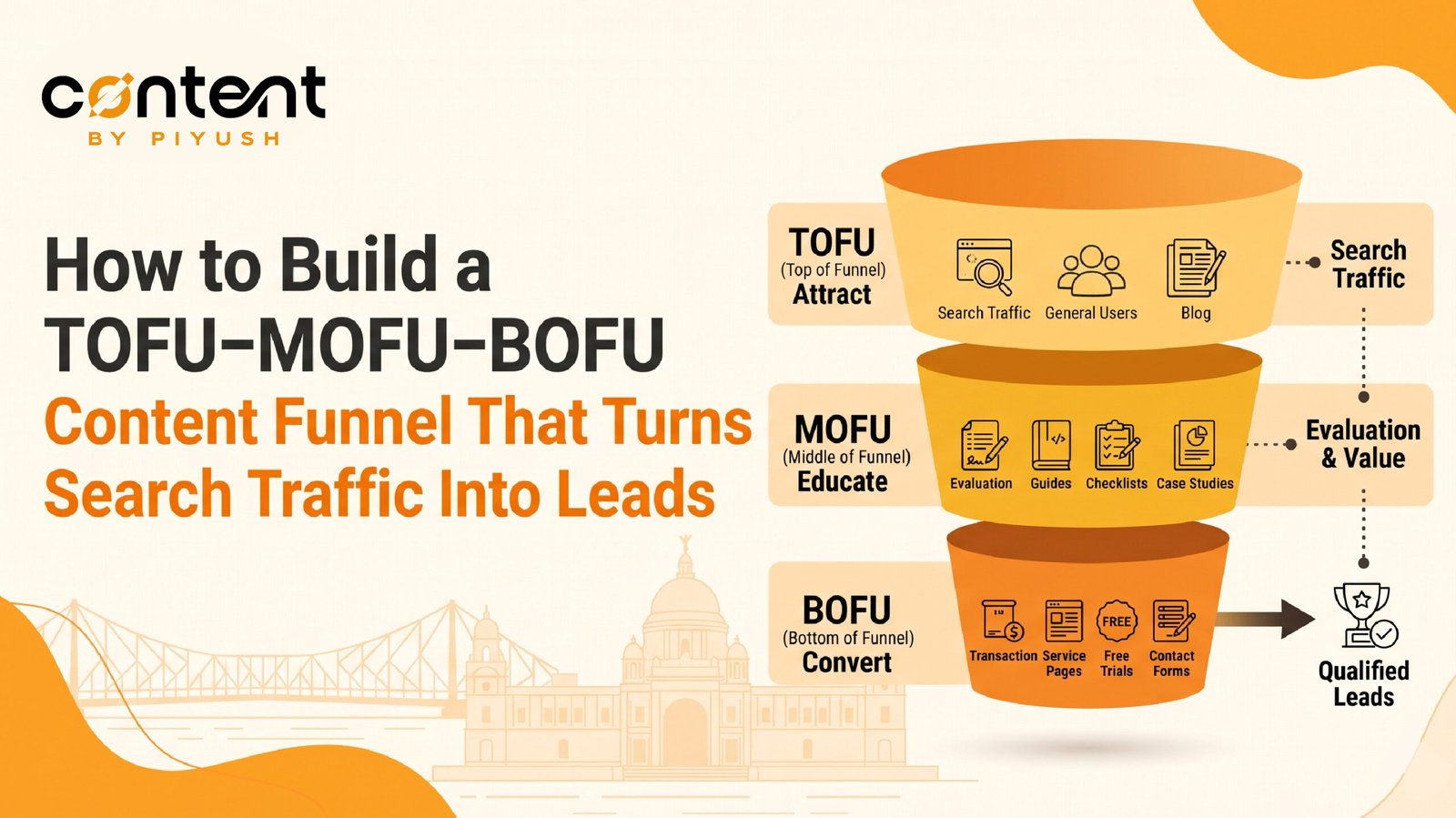
A TOFU–MOFU–BOFU content funnel solves that problem by matching content with the questions people ask as they move from “I have a problem” to “What can solve it?” to “Who should I hire?”
The goal is not to force every reader through a rigid funnel. It is to make sure useful content exists when their questions become more specific.
What Do TOFU, MOFU and BOFU Mean?
TOFU — Top of Funnel
The audience is discovering or understanding a problem.
Example: Why Is Your Website Getting Google Impressions but Not Enough Clicks?
MOFU — Middle of Funnel
The audience knows the problem and is evaluating possible approaches.
Example: Content Audit vs New Content.
BOFU — Bottom of Funnel
The audience is evaluating providers, costs or implementation options.
Example: SEO Content Writing Services in India.
The service page then handles the most direct commercial intent.
The ContentByPiyush 4-Layer Organic Content Funnel
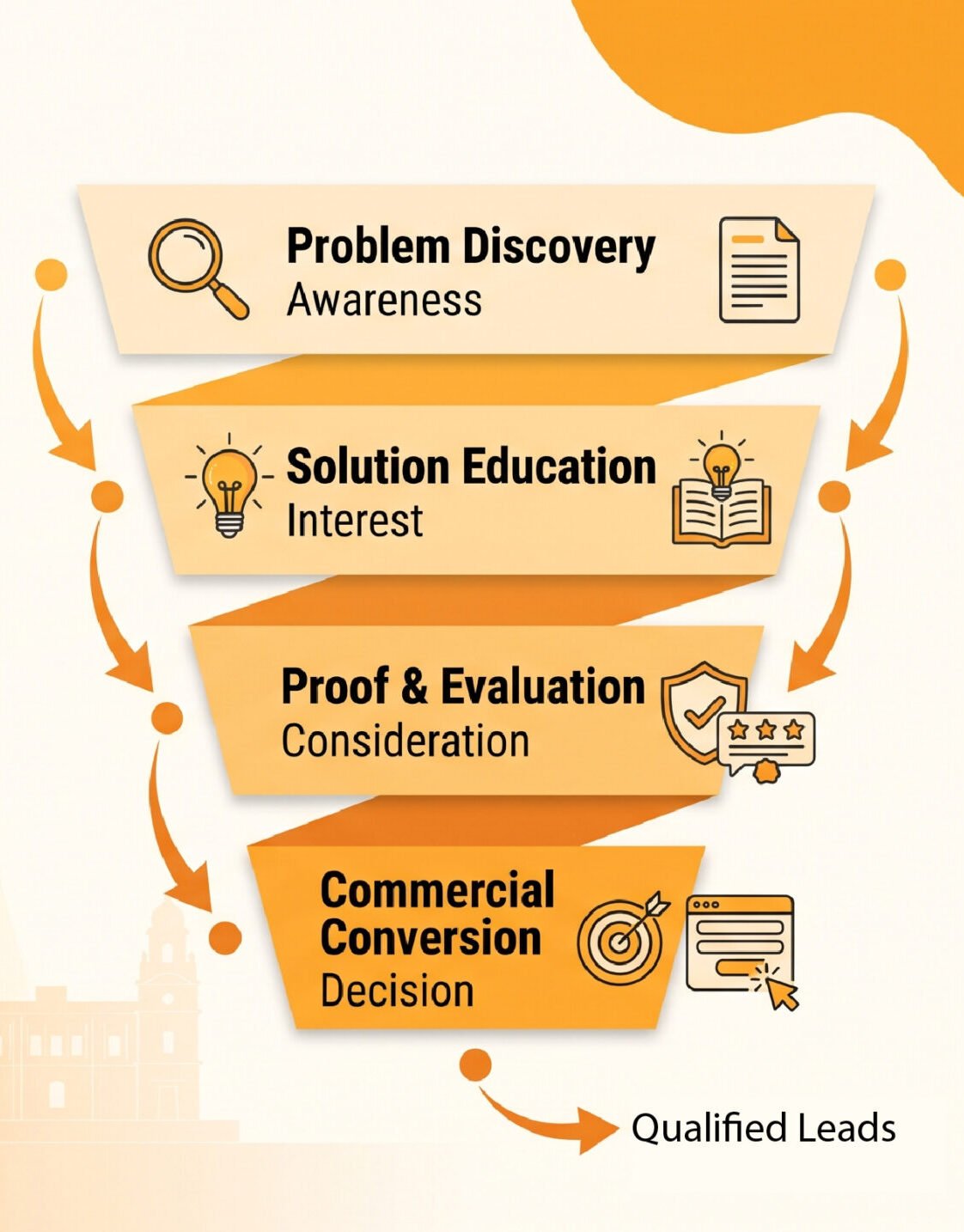
Rather than treating TOFU, MOFU and BOFU as three isolated labels, use four connected layers.
Layer 1 — Problem Discovery
Question: What is going wrong?
Content examples include Why Is Your Website Getting Google Impressions but Not Enough Clicks? and Why Is Your Content Marketing Getting Traffic but Not Generating Qualified Leads?
Objective: create problem awareness and provide a useful diagnosis.
Layer 2 — Solution Education
Question: What should I do about it?
Content examples include Content Audit vs New Content, SEO content strategy frameworks and content-refresh strategies.
Objective: help the reader understand possible approaches.
Layer 3 — Proof & Evaluation
Question: Who can solve this and what should I expect?
Content examples include case studies, agency vs freelancer, service costs, selection checklists and implementation examples.
Objective: reduce buyer uncertainty.
Layer 4 — Commercial Conversion
Question: How can I work with someone?
Pages include SEO Content Writing Services, Content Strategy Services, Website Content Writing Services and Blog Writing Services.
Objective: make the service and next step completely clear.
Example: Building an SEO Content Funnel
Suppose your service is SEO Content Writing Services.
TOFU
Why Is Your Website Getting Google Impressions but Not Enough Clicks?
MOFU
BOFU
SEO Content Writing Services in India: Cost & Hiring Guide
PROOF
SERVICE
This creates an actual commercial content system.
Example: Building a Content Marketing Funnel
TOFU
Why Is Your Content Marketing Getting Traffic but Not Generating Qualified Leads?
MOFU
How to Build a TOFU–MOFU–BOFU Content Funnel
BOFU
How to Choose the Best Content Marketing Agency in India
PROOF
Relevant organic-growth case study
SERVICE
Every article has a different job.
How Should Keywords Change Across the Funnel?
Stage | Typical Search |
TOFU | why is content not generating leads |
TOFU | what is SEO content writing |
MOFU | content audit vs new content |
MOFU | agency vs freelancer |
BOFU | SEO content writing services India |
BOFU | best content marketing agency India |
BOFU | content marketing agency pricing |
This is why a website should not judge opportunities only by search volume. Lower-volume commercial queries can be extremely valuable.
Where Do SEO, AEO and GEO Fit Into the Funnel?
They work across every stage.
SEO
Determines how the content maps to actual organic demand.
AEO
Ensures each stage answers the reader’s specific question clearly.
GEO
Strengthens the content as a potential source for generative answers.
The same strong search fundamentals support all three. The difference is the type of question and the buyer stage being addressed.
How Do You Build a Content Funnel From Scratch?
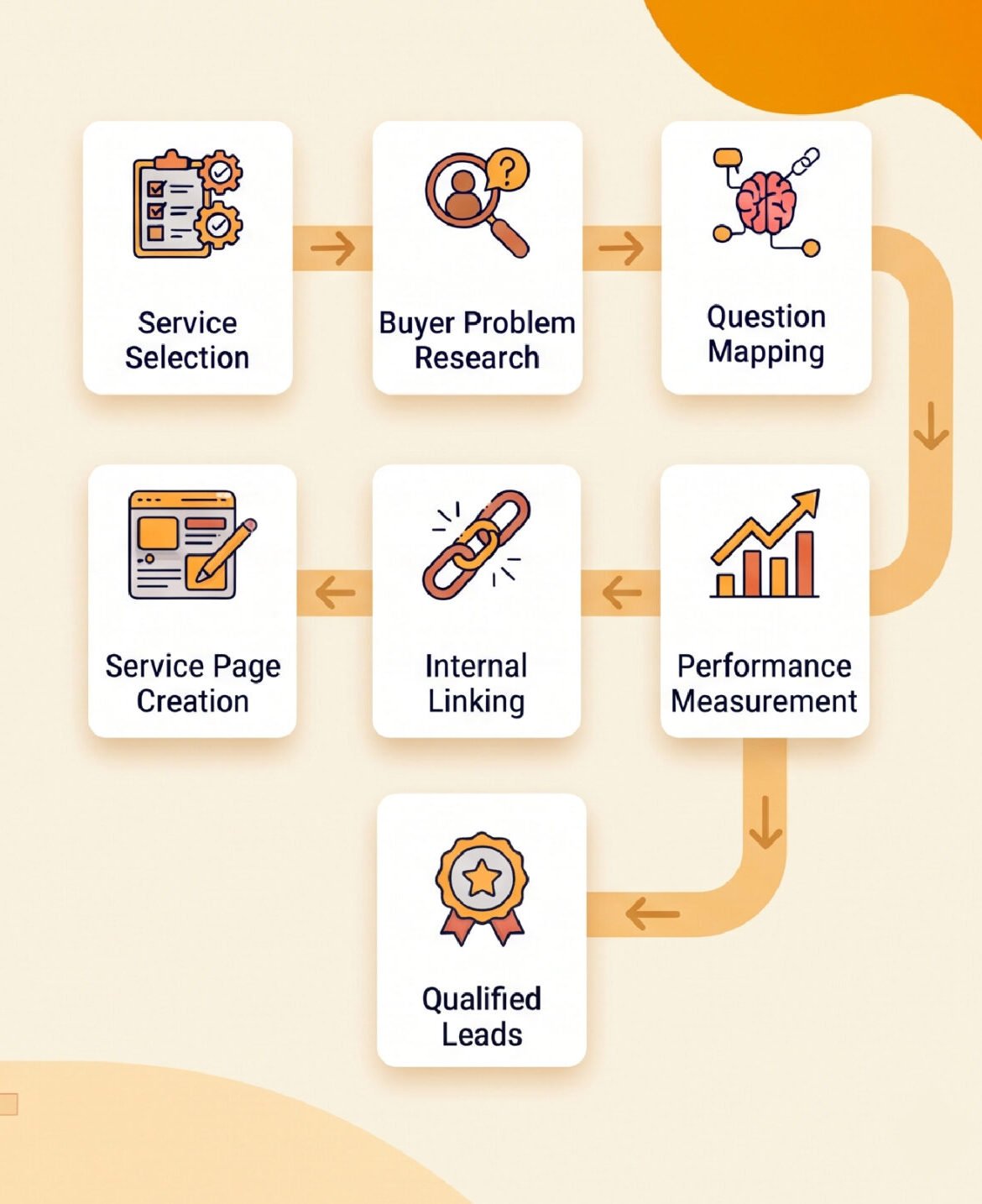
Step 1 — Start With the Service
Choose one commercial service. Example: Content Strategy Services.
Step 2 — Identify Buyer Problems
List what happens before someone needs the service. Examples: content gets no traffic, traffic does not convert, topics are chosen randomly, content overlaps or teams do not know what to publish.
Step 3 — Map Questions by Stage
TOFU asks why this is happening. MOFU asks how it should be solved. BOFU asks who should be hired.
Step 4 — Create the Service Page
Do not wait until after producing 30 blogs. Your commercial destination should already exist.
Step 5 — Add Proof
Publish relevant case studies, testimonials, results and methodology.
Step 6 — Connect Everything Internally
Create contextual links based on the reader’s likely next question.
Step 7 — Measure the Journey
Track organic entrances, next-page paths, service-page visits, enquiries, qualified leads, cited pages and AI referral traffic.
How Many TOFU, MOFU and BOFU Articles Do You Need?
There is no ideal ratio.
A company with strong brand demand might need more BOFU. A new category may require more educational TOFU content. A mature blog with lots of traffic but few leads probably needs more MOFU, BOFU and service-page optimization.
The right balance should be based on the gaps in your current journey.
What Are Common Content Funnel Mistakes?
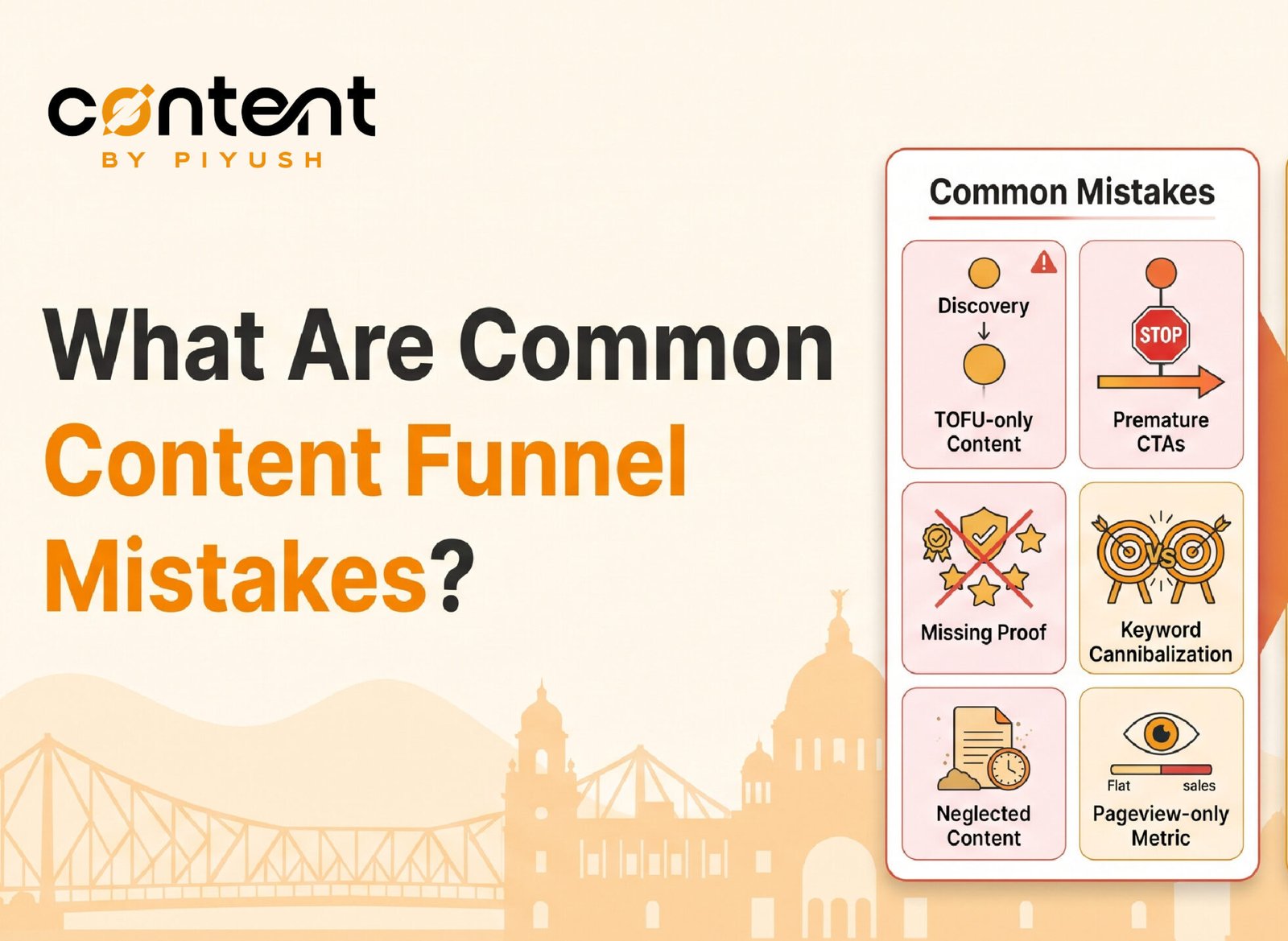
Mistake 1: Publishing TOFU Only
Traffic grows but commercial intent remains weak.
Mistake 2: Sending Every Blog to “Contact Us”
The reader may not be ready.
Mistake 3: Creating BOFU Without Proof
Provider pages make large claims with no evidence.
Mistake 4: Keyword Cannibalization
Several pages target the same stage and query.
Mistake 5: Ignoring Existing Content
New articles are produced while older high-potential URLs decay.
Mistake 6: Measuring Only Pageviews
Content has no defined business outcome.
Can a Content Marketing Agency Build the Funnel for You?
Yes. A full-funnel engagement can include content audit, buyer-journey mapping, keyword research, TOFU/MOFU/BOFU mapping, topic clusters, service pages, content briefs, SEO writing, case studies, internal links and performance measurement.
Ask the agency to show you how the pieces connect. A calendar containing 30 blog titles is not automatically a strategy.
How Can Content Funnels Improve AI-Search Visibility?
AI systems often respond to highly specific questions. A full funnel naturally creates coverage around problem questions, solution questions, comparison questions and provider questions.
That broader topical coverage can make a website relevant across more retrieval contexts. However, avoid producing thin pages for every possible question. Build fewer, stronger resources where the intent overlaps.
Final Takeaway
A strong content funnel does not begin with “What should we publish this month?”
It begins with: “What does our customer need to understand before they are ready to work with us?”
Build content around that journey, then connect Problem → Solution → Proof → Service.
Need a Content Funnel Built Around Your Services?
Content by Piyush can help turn disconnected keywords and blogs into a TOFU–MOFU–BOFU content roadmap aligned with search demand and buyer intent.
Explore Content Strategy Services. If you need implementation after strategy, continue into SEO Content Writing Services, Blog Writing Services or Website Content Writing Services.

Piyush Sethia
Co-Founder | Content Marketer and Strategist
Recognised as the 2026 Tally MSME Business 'Tech Transformer' Award winner, Piyush Sethia leverages advanced tech facilities to transform content marketing and writing efficiency. With over a decade of experience, he specializes in data-backed content marketing, AIO, GEO, SEO strategy, and organic growth blueprints. He is also the author of The Clarity of Confusion, showcasing his unique ability of storytelling and simplifyinig complex landscapes into crystal-clear narratives. His expertise lies in converting technical data and deep audience insights into engaging, search-optimized strategies that drive sustainable traffic.
No Responses