
Getting more content published was never the objective.
The objective was to make the website useful enough across an important group of topics that people could find it at different stages of their search journey, and search engines could clearly understand where its expertise belonged.
Through a structured, content-led SEO strategy, the website eventually gained visibility across 500+ search keywords and began appearing in Google AI Overviews for relevant searches.
The result did not come from stuffing articles with keywords or publishing dozens of unrelated blogs.
It came from connecting search intent, topic clusters, helpful content, internal links, first-hand expertise and commercial pages into one content system.
This case study explains what changed, why the strategy worked and what businesses can learn from it.
Results at a Glance
Metric | Result |
Ranking keywords | 500+ |
Google AI Overview visibility | Achieved for relevant queries |
Primary strategy | Content-led SEO |
Content approach | Search intent + topic clusters + E-E-A-T |
Funnel coverage | TOFU + MOFU + BOFU |
Commercial objective | Build qualified organic visibility |
These numbers matter.
But they are not the complete story.
Ranking for 500 keywords is only useful when those keywords relate to topics capable of bringing the right audience closer to the business.
That distinction shaped the strategy from the beginning.
The Problem: Publishing Content Without Building Search Authority
Like many growing websites, the business already understood that content could contribute to organic visibility.
The problem was not whether to create content.
The bigger questions were:
- Which topics should be prioritized?
- Which searches actually mattered commercially?
- How should informational blogs support service pages?
- Which topics belonged together?
- How could existing expertise be turned into content search engines could understand and users could trust?
Publishing isolated articles would have produced activity.
It would not necessarily have produced authority.
The strategy therefore moved away from:
keyword → article → publish
toward:
business objective → search intent → topic cluster → supporting content → proof → commercial page.
Why Ranking for More Keywords Was Not the First Goal
It is easy to make “number of ranking keywords” the headline SEO metric.
That can be misleading.
A website could technically rank for hundreds of low-value queries that never bring a relevant potential customer.
The more useful objective was to build visibility around searches connected to the business’s actual areas of expertise.
That meant examining three layers of intent.
Informational Intent
These searchers were trying to understand a problem.
Content at this level needed to educate without forcing an immediate sales message.
Commercial Research Intent
These users already understood the problem and were evaluating possible approaches.
They needed deeper comparisons, frameworks, examples and evidence.
Transactional Intent
These searches indicated stronger buying intent.
Service pages, case studies and decision-stage content had to provide enough information for the prospect to evaluate the business.
Instead of treating those three stages separately, the content strategy connected them.
Step 1: We Started With Search Intent Instead of Search Volume
Keyword volume is useful.
But it cannot tell you whether a query matters to your business.
A search with 10,000 monthly searches can generate less commercial value than a specific query with 200 searches if the latter reflects a real buyer problem.
Topics were therefore evaluated against questions such as:
- Who is searching for this?
- What problem are they trying to solve?
- What would they expect to see after clicking?
- Is the query informational or commercial?
- Does the business have genuine expertise in the subject?
- Is there a relevant product or service behind the topic?
- Which page should the article ultimately support?
This prevented the content calendar from becoming a collection of disconnected high-volume keywords.
Step 2: Related Keywords Became Topic Clusters
Ranking one article was not enough.
The website needed broader topical coverage.
Related searches were grouped into clusters around key subjects.
A simplified cluster might look like:
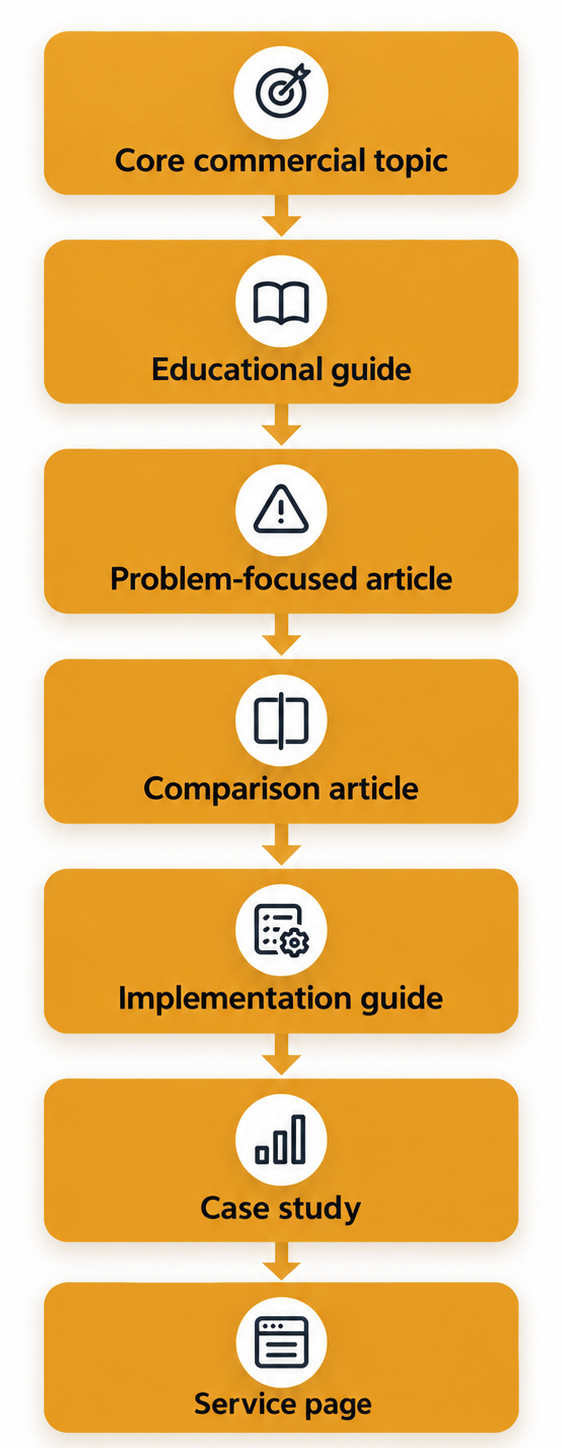
Each article had a specific role.
The educational article could introduce the topic.
A middle-of-the-funnel article could explain methodology.
The case study could provide evidence.
The service page could convert established demand.
This also made internal linking more meaningful because pages were connected based on genuine topical relationships.
Step 3: We Stopped Treating TOFU Content as an End Point
Informational traffic can look impressive in analytics.
But traffic alone does not create a content marketing system.
Every major informational article was therefore assessed for its logical next step.
For example:
A reader learning about a problem could be directed toward a more advanced strategy article.
A reader researching implementation could see a relevant case study.
A reader comparing providers could move toward the service page.
The objective was not to force every visitor into a sales funnel.
It was to make sure useful next steps existed whenever the reader was ready for them.
That transformed internal links from an SEO checkbox into part of the customer journey.
Step 4: We Built Content Around Complete Questions, Not Keyword Density
Traditional SEO writing often revolves around questions such as:
“How many times should the primary keyword appear?”
That was not the approach here.
The more useful question was:
What would somebody genuinely need to know before considering this question answered?
Each article was structured around:
- the main search intent
- important supporting questions
- related concepts
- practical examples
- relevant comparisons
- factual evidence
- next-step questions
Primary keywords still mattered.
But they acted as topic signals rather than writing instructions.
This allowed the articles to cover related long-tail searches naturally.
As that topical coverage expanded, the site began appearing for a wider range of relevant queries.
Step 5: E-E-A-T Was Demonstrated Rather Than Declared
Adding “written by an expert” underneath an article does not automatically make the article authoritative.
Experience and expertise have to appear inside the content.
Where appropriate, pages were strengthened through:
First-hand observations
What had actually been seen or learned from working on the problem.
Specific examples
Concrete situations rather than generic statements.
Reliable sources
Primary or authoritative references for factual claims.
Clear authorship
A visible connection between the content and the person responsible for it.
Case-study evidence
Actual outcomes instead of unsupported promises.
Transparent methodology
An explanation of how conclusions or numbers were produced.
This matters because trust is much easier to establish when readers can understand where the information came from.
Step 6: Existing Content Was Improved Instead of Constantly Replaced
Creating a new article is not always the best SEO decision.
Existing pages can already have:
- search impressions
- backlinks
- historical relevance
- indexed keywords
- internal links
Rather than continuously producing additional URLs around similar subjects, existing pages were evaluated for improvement opportunities.
That could include:
- updating old information
- improving search-intent alignment
- strengthening introductions
- adding missing questions
- consolidating overlapping content
- adding internal links
- improving calls to action
- expanding thin sections
- removing unsupported claims
This helped concentrate relevance instead of spreading it across unnecessary pages.
Step 7: Commercial Pages Became Part of the Content Strategy
Blogs cannot do all the work.
A user searching for educational information and someone searching for a service have different expectations.
Commercial service pages therefore needed their own clearly defined intent.
Supporting articles then reinforced those pages.
The architecture became:
Educational content
↓
Evaluation content
↓
Evidence
↓
Service page
This allowed the blog to support commercial visibility instead of existing as an independent publishing section.
How the Website Reached 500+ Ranking Keywords
The growth in ranking keywords did not come from trying to create a separate page for every keyword variation.
It came from building deeper relevance around connected topics.
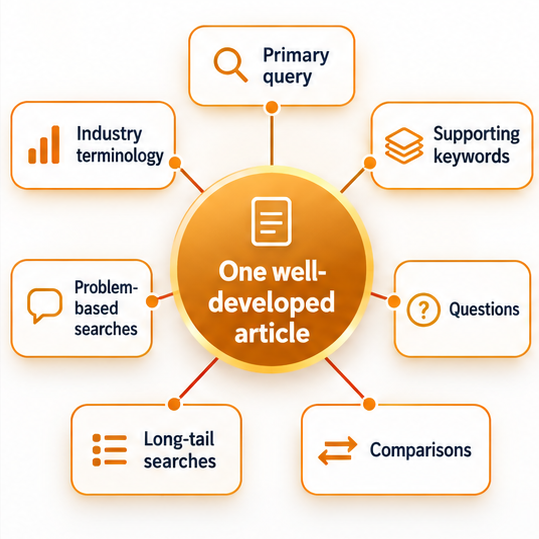
One well-developed article can naturally become relevant to:
- a primary query
- supporting keywords
- questions
- comparisons
- long-tail searches
- problem-based searches
- industry terminology
That is why tracking only one keyword per page can underestimate the value of strategically developed content.
By creating stronger topic clusters and answering a wider set of relevant questions, the website expanded its organic search footprint to more than 500 keywords.
How the Website Started Appearing in Google AI Overviews
Google AI Overviews create a different visibility opportunity.
A website is no longer competing only to become a traditional blue link.
Its information can also be retrieved as supporting evidence within an AI-generated answer.
There was no separate “AI Overview hack” applied to the website.
Instead, the content already followed principles that made important information easier to understand and retrieve:
- clear subject focus
- specific headings
- direct answers
- strong topical context
- supporting evidence
- first-hand expertise
- internal connections between related pages
- accurate information
- accessible text
The site subsequently began appearing in Google AI Overviews for relevant queries.
This distinction is important.
No SEO or content provider can guarantee that Google will cite a particular website in an AI Overview.
The goal is to make the website a stronger candidate for retrieval by consistently publishing information that is useful, relevant, trustworthy and accessible.
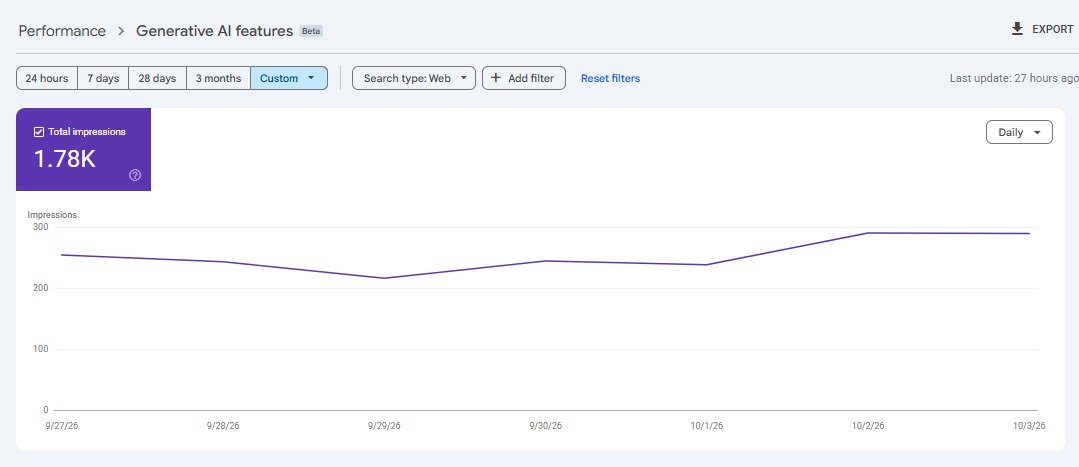
Why AI Visibility and SEO Visibility Need to Be Measured Together
Traditional search visibility still matters.
AI search adds additional metrics rather than replacing existing ones.
A useful reporting framework can include:
Traditional SEO Metrics | AI Search Metrics |
Ranking keywords | AI citations |
Organic impressions | AI Overview impressions |
Organic clicks | Cited URLs |
Average position | Citation topics |
Organic sessions | AI referral traffic |
Conversions | AI-assisted conversions |
Branded searches | Brand mentions in AI answers |
This gives businesses a more realistic view of modern search performance.
A page might influence a prospect without producing the first click.
A user may encounter a brand inside an AI-generated answer, remember the name and later search for the company directly.
Visibility therefore needs to be evaluated across the full discovery journey.
What This Case Study Taught Us
The biggest lesson was not that businesses need more content.
They need better-connected content.
The strongest results came from treating the website as an information system rather than a collection of articles.
That required:
Choosing commercially relevant topics
not chasing traffic for its own sake.
Building topical depth
rather than producing unrelated blogs.
Matching search intent
instead of focusing solely on keyword volume.
Connecting content internally
so readers and search engines could understand relationships between pages.
Demonstrating experience
instead of relying on generic claims of expertise.
Publishing evidence
so the business had information worth trusting and referencing.
Supporting service pages
so traffic had a commercial destination.
500 Ranking Keywords Do Not Automatically Equal SEO Success
This point deserves emphasis.
Keyword count is a useful visibility indicator.
It is not the final business outcome.
A successful content strategy should eventually contribute to metrics such as:
- qualified organic traffic
- commercial keyword visibility
- branded searches
- enquiries
- demo requests
- calls
- sales opportunities
- revenue
If a website grows from 100 ranking keywords to 1,000 but none relate to potential customers, the strategy may still be weak.
The 500+ keyword milestone mattered in this project because the broader visibility developed around topics connected to the business’s actual expertise.
What Businesses Can Apply From This Strategy
You do not need hundreds of articles before building topical authority.
Start by identifying one commercially important service.
Create the strongest possible service page around that intent.
Then map the questions a potential buyer asks:
- before understanding the problem
- while researching possible solutions
- while comparing approaches
- while evaluating providers
Create content for those stages.
Connect the articles.
Add proof.
Update them using performance data.
Only then expand into the next cluster.
That creates a much stronger foundation than publishing unrelated keywords every week.
Need an SEO Content Strategy That Connects Rankings With Business Growth?
Content should not exist simply because a keyword tool says a topic has search volume.
It should help the right audience discover your expertise, understand your approach and move toward the services your business provides.
Content by Piyush helps businesses develop SEO content around search intent, topic authority, evidence and the customer journey, from strategy and briefs through long-form execution.
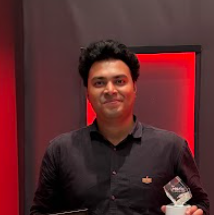
Piyush Sethia
Co-Founder | Content Marketer and Strategist
Recognised as the 2026 Tally MSME Business 'Tech Transformer' Award winner, Piyush Sethia leverages advanced tech facilities to transform content marketing and writing efficiency. With over a decade of experience, he specializes in data-backed content marketing, AIO, GEO, SEO strategy, and organic growth blueprints. He is also the author of The Clarity of Confusion, showcasing his unique ability of storytelling and simplifyinig complex landscapes into crystal-clear narratives. His expertise lies in converting technical data and deep audience insights into engaging, search-optimized strategies that drive sustainable traffic.
No Responses