
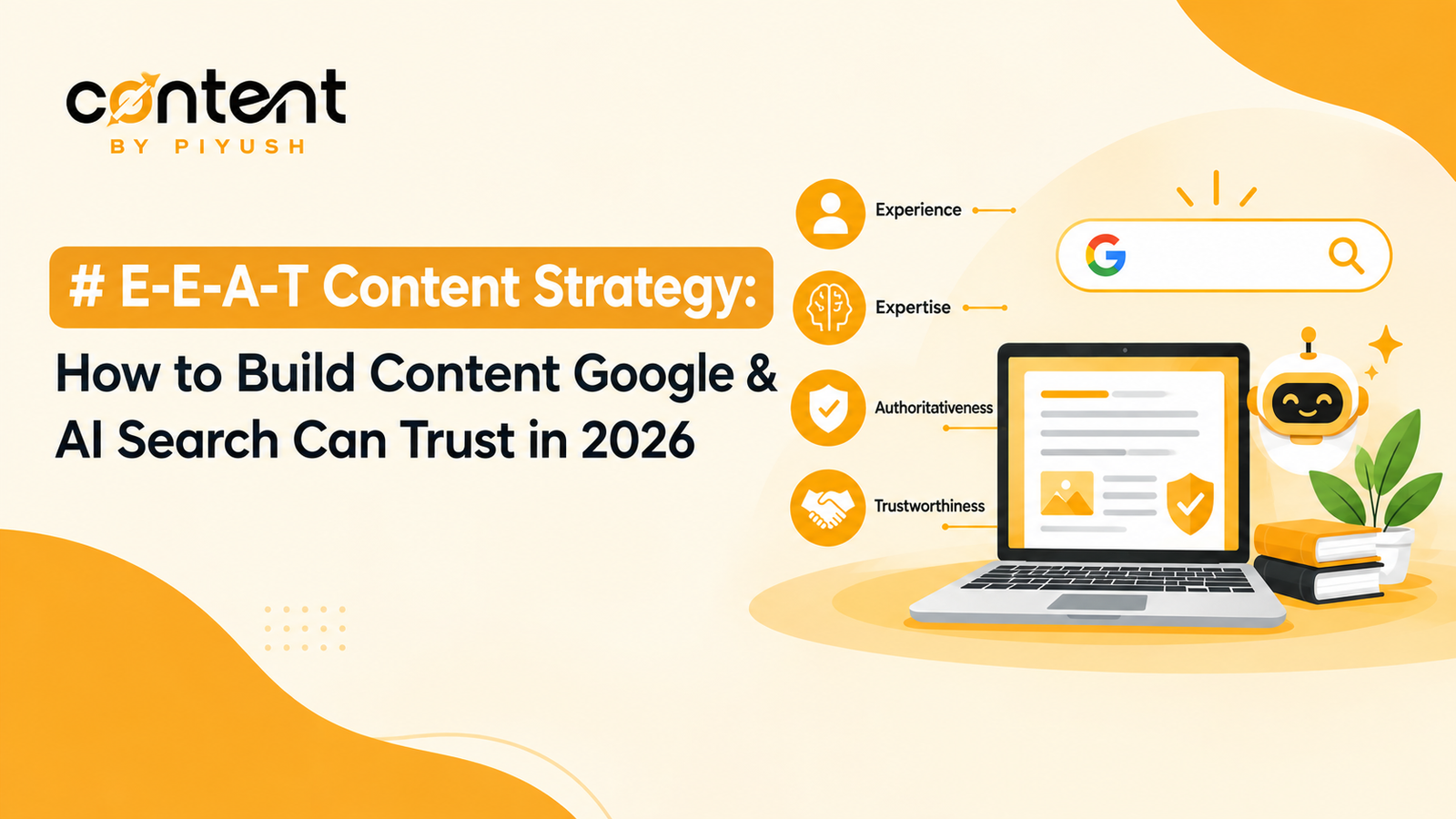
What Is an E-E-A-T Content Strategy?
An E-E-A-T content strategy is a systematic approach to creating and improving content so that readers can see real Experience, Expertise, Authoritativeness and Trust behind the information.
It is not about adding an author bio to an otherwise generic article.
A strong E-E-A-T strategy connects:
- real experience
- qualified expertise
- original evidence
- credible sourcing
- clear authorship
- strong topical coverage
- site-level trust
to produce content people can confidently use.
Google makes an important distinction here.
E-E-A-T itself is not a specific Google ranking factor.
Instead, Google says its ranking systems use a mix of signals that can identify content demonstrating qualities associated with strong E-E-A-T. Google also states that Trust is the most important part of E-E-A-T, with Experience, Expertise and Authoritativeness contributing to it.
For businesses trying to rank in both traditional and AI-driven search, the practical objective is therefore not:
“How do we optimize an E-E-A-T score?”
It is:
“How do we give users, Google and AI systems enough verifiable evidence to trust what we publish?”
Why E-E-A-T Matters More in the AI Search Era
The web has never had more content.
Producing words has become inexpensive.
Producing credible information has not.
Generative AI can quickly create:
- definitions
- generic tips
- summaries
- introductions
- lists
- basic comparisons
That makes generic content easier to replace.
Google’s July 2026 guidance for generative Search specifically recommends creating valuable, unique and non-commodity content that provides perspectives or experiences beyond information already widely available online or easily reproduced by a generative model.
That changes competitive SEO.
Five years ago, a business might compete by publishing:
10 Content Marketing Tips
Today, an AI model can answer that query instantly.
A stronger content asset might be:
We Audited 75 Business Blogs: The 9 Problems Behind Pages That Get Impressions but No Leads
The difference is not formatting.
It is information advantage.
That is why E-E-A-T, SEO, AEO and GEO are increasingly connected.
E-E-A-T, SEO, AEO and GEO: How Do They Work Together?
Businesses often treat these as separate optimization systems.
That creates unnecessary complexity.
A better framework is:
Area | Main Objective |
SEO | Help search engines discover, understand and rank content |
E-E-A-T | Demonstrate why the information deserves trust |
AEO | Make important answers easy to identify and understand |
GEO | Make content useful as a source in generative search experiences |
Content Strategy | Connect all of the above to audience and business objectives |
Google’s latest guidance is explicit that proven SEO practices remain foundational for generative Search.
It specifically recommends strong technical SEO, useful original content and people-first experiences rather than supposed GEO hacks such as artificial content chunking, unnecessary AI-specific text files or manufactured mentions.
Therefore:
- SEO gets you considered.
- Clear answers get you understood.
- E-E-A-T gives your claims credibility.
- Original information makes you worth citing.
First: Stop Treating E-E-A-T as a Checklist
A common E-E-A-T audit looks like this:
- Author bio? ✓
- About page? ✓
- LinkedIn link? ✓
- Sources? ✓
- Schema? ✓
Done.
That misses the point.
Imagine an article titled:
How to Increase Organic Traffic
It contains:
- an author box
- ten outbound sources
- Article schema
- a professional headshot
But every recommendation is copied conceptually from competing articles.
Does the page suddenly demonstrate exceptional experience?
No.
E-E-A-T should appear inside the information itself.
A reader should be able to tell:
- This person has done this.
- This claim can be checked.
- This conclusion came from evidence.
- This business understands the subject.
That is much stronger than adding trust decorations around generic copy.
The Four Parts of E-E-A-T Explained
1. Experience
Experience answers:
Have you actually done, used, tested, managed or experienced what you are discussing?
Examples include:
- using the software you review
- managing an SEO campaign
- writing content for a regulated industry
- operating an e-commerce business
- implementing a content strategy
- visiting a destination
- interviewing customers
- testing products
Google added the additional “E” for Experience because first-hand experience can be valuable independently of formal expertise.
Experience in content writing
Weak:
Internal linking can improve SEO.
Stronger:
During our content audits, one recurring issue is informational articles receiving impressions while remaining disconnected from the service pages they are supposed to support. We therefore map every major article to at least one logical next-stage destination.
The second statement demonstrates a process.
2. Expertise
Expertise asks:
Does the creator genuinely understand the subject?
Expertise can come from:
- professional experience
- qualifications
- specialist knowledge
- long-term practice
- research
- training
- documented subject knowledge
The type of expertise required depends heavily on the subject.
A first-hand travel recommendation may reasonably come from someone who actually visited the destination.
Medical treatment advice should meet a considerably higher expertise threshold.
Google states that its systems place greater weight on signals aligning with strong E-E-A-T for Your Money or Your Life (YMYL) topics that can materially affect health, financial stability, safety or societal welfare.
This is why a finance article and a fashion styling article should not use the same editorial review standard.
3. Authoritativeness
Authority asks:
Are you or your website recognized as a useful source on this subject?
Authority rarely comes from saying:
“We are an industry-leading company.”
It develops through corroboration.
Examples include:
- respected websites mentioning you
- people linking to your research
- experts quoting your work
- conference appearances
- professional profiles
- published books
- industry recognition
- customer recommendations
- interviews
- partnerships
- citations
Authority is therefore partly a content problem and partly a brand problem.
Your website tells people who you are.
The wider web helps validate that claim.
4. Trust
Trust asks:
Can I safely rely on this information and the organization publishing it?
Google explicitly identifies Trust as the most important E-E-A-T component.
Trust can be strengthened by:
- accurate claims
- primary sources
- visible authorship
- corrections
- realistic promises
- proper methodology
- secure website experience
- clear company details
- authentic testimonials
- accurate dates
- transparent commercial relationships
- clear distinctions between fact and opinion
Trust can also disappear quickly.
One invented statistic can damage a page containing 20 correct ones.
That is why ContentByPiyush should continue avoiding unsupported client metrics simply because they make a headline sound stronger.
Google’s “Who, How and Why” Framework
One of the most useful practical frameworks Google gives content creators is:
Who → How → Why
Google recommends assessing content around these three questions.
WHO Created the Content?
Users should be able to understand who is responsible for the information.
Ask:
- Is there a real author?
- Is there a byline?
- Does the byline link to an author page?
- Does the author have relevant experience?
- Are credentials verifiable?
- Can users find more work by the same author?
Poor
Author: Admin
Better
Piyush Sethia — Content Marketer & Strategist
followed by relevant expertise and links to a complete author profile.
Google supports ProfilePage structured data for pages focused on a creator or organization, including author profile and About Me pages.
HOW Was the Content Created?
This becomes particularly important for:
- research
- reviews
- comparisons
- case studies
- AI-assisted content
- tests
- rankings
If an article says:
We analyzed 100 websites
tell the reader:
- Which websites?
- How were they selected?
- When?
- Which variables were measured?
- Which tools were used?
- What limitations existed?
Google explicitly says explaining how content was produced can build trust and recommends context where automation or AI played a significant role.
WHY Was the Content Created?
This is perhaps the most important question.
Google says the appropriate “why” is to create content primarily to help people—not primarily to attract search traffic.
This doesn’t mean commercial content is bad.
A service provider can absolutely publish content that supports sales.
The problem arises when the page has no useful purpose beyond:
“this keyword has 2,000 searches.”
A useful MOFU article may educate the reader while naturally demonstrating that the business can solve the problem.
That is exactly how this article should function.
How to Build an E-E-A-T Content Strategy in 2026
A practical strategy can be divided into eight layers.
1. Establish a Clear Area of Expertise
A website cannot build meaningful topical authority by publishing about everything.
Start by answering:
What do we genuinely want this brand to be known for?
For ContentByPiyush, the core areas should remain closely connected to its services:
Article & Blog Writing
Supporting subjects:
- article structure
- blog strategy
- SEO blogging
- editorial quality
- storytelling
- research
- thought leadership
Website Content Writing
Supporting subjects:
- homepage writing
- service pages
- landing pages
- brand messaging
- conversion copy
- website architecture
SEO Content Writing
Supporting subjects:
- search intent
- keyword mapping
- E-E-A-T
- SEO writing
- AEO
- GEO
- AI search
- internal linking
Content Strategy
Supporting subjects:
- content funnels
- topic clusters
- content audits
- competitor analysis
- measurement
- content refresh
- editorial planning
Research & Analysis
Supporting subjects:
- original data
- competitor research
- source verification
- market research
- case studies
- benchmarking
These categories reinforce one central entity:
ContentByPiyush → Content Writing + SEO Content + Content Strategy + AI Search Visibility
That association becomes diluted if the site starts publishing unrelated high-volume trends simply to acquire traffic.
2. Map Authors to Topics They Can Credibly Own
Not every writer should author every subject.
Build an expertise matrix.
Content Topic | Suitable Author/Reviewer |
Content writing | Experienced content writer |
SEO content strategy | SEO/content strategist |
Finance | Finance SME/reviewer |
Medical | Appropriate healthcare professional |
Legal | Legal subject expert |
Product review | Person who tested the product |
Case study | Strategist/person involved in project |
For a personal brand such as ContentByPiyush, this becomes especially valuable.
Piyush should be closely associated with subjects where he can demonstrate:
- direct experience
- previous work
- processes
- results
- professional recognition
- public profiles
Do not attach an impressive author biography to unrelated topics merely to manufacture authority.
Relevance matters.
3. Replace Generic Content With Evidence-Led Content
Generic articles usually state conclusions.
Expert articles show how the conclusion was reached.
Compare:
Generic
Content audits are important for SEO.
Evidence-led
During a content audit, divide URLs into four categories: retain, refresh, consolidate and remove. The decision should consider traffic, impressions, ranking overlap, intent and commercial relevance rather than page age alone.
The second passage provides a framework.
Better still:
We applied the same process to 82 URLs and found 17 pages targeting overlapping intent.
Now the content contains proprietary evidence.
Five evidence levels
Use this hierarchy where possible:
Level 1 — Primary Data
Your own:
- Search Console
- GA4
- customer survey
- test
- experiment
- analytics
Level 2 — First-Party Industry Sources
Examples:
- OpenAI
- government
- platform documentation
Level 3 — Original Third-Party Research
Examples:
- Semrush study
- Ahrefs study
- Pew Research
Level 4 — Expert Commentary
Credible specialists explaining interpretation.
Level 5 — Secondary Summaries
Useful where necessary, but weaker than the original evidence.
When a primary source exists, cite it.
4. Add Information Gain to Every Important Page
Before creating a new article, ask:
What is this page contributing to the web?
Potential contribution could be:
- an original framework
- new dataset
- practical workflow
- tested example
- specific opinion
- proprietary model
- real case study
- expert interview
- calculator
- template
- checklist
- benchmark
Google’s latest AI Search guidance specifically emphasizes content that adds a unique perspective rather than recycling information already available elsewhere.
This is arguably the single most important change businesses should make to their content operations in 2026.
5. Build Topic Clusters Around Expertise
One expert article does not automatically create authority.
A coherent group of useful resources is more persuasive.
For example:
Cluster: SEO Content Strategy
TOFU
15 Content & SEO Mistakes That Stop Websites From Ranking
↓
MOFU
E-E-A-T Content Strategy: How to Build Content Google & AI Search Can Trust
↓
Supporting articles
- SEO vs AEO vs GEO
- How to Get Cited by AI
- Search Intent Guide
- Content Audit Guide
- Internal Linking Strategy
- AI Search Visibility Guide
↓
BOFU
How Content by Piyush Helped a Business Rank for 500+ Keywords and Gain Google AI Overview Visibility
↓
Service Page
SEO Content Writing / Content Strategy Services
This structure accomplishes several things.
It demonstrates subject depth.
It creates internal linking opportunities.
It guides readers through the funnel.
And it helps avoid publishing unrelated articles simply because they contain keywords.
6. Build Clear Answer Architecture for AEO
E-E-A-T does not mean making content academically complicated.
Authority should improve clarity.
A useful answer structure is:
Question → Direct Answer → Evidence → Context → Example
For example:
Is E-E-A-T a Google ranking factor?
No. E-E-A-T itself is not a specific ranking factor. Google says its automated systems use multiple signals designed to identify content demonstrating qualities associated with Experience, Expertise, Authoritativeness and Trust.
Then explain.
This structure is useful for:
- featured results
- voice/answer experiences
- AI retrieval
- human scanning
A Semrush analysis published in January 2026 found several content features occurring more frequently among AI-cited pages than comparable Google-ranking pages:
Characteristic | Positive Association |
Clarity and summarization | +32.83% |
E-E-A-T signals | +30.64% |
Q&A format | +25.45% |
Section structure | +22.91% |
Structured-data elements | +21.60% |
These are correlations, not confirmed ranking factors.
The practical lesson is simply:
Make expertise easy to extract without making the writing robotic.
7. Create Brand Authority Beyond Your Own Website
A business cannot establish authority only by repeatedly describing itself as authoritative.
External corroboration matters.
Potential sources include:
- respected industry publications
- client sites
- professional platforms
- interviews
- podcasts
- awards
- conferences
- YouTube
- expert communities
- research citations
- independent recommendations
AI visibility has made this particularly interesting.
Semrush’s June 2026 study found that around 62% of analyzed AI citations were “ghost citations” where the source was cited without the brand being explicitly named.
This means you should track two separate outcomes:
Citation authority
Is your website being used as a source?
Entity authority
Is your brand actually being named?
They are not the same.
A strong E-E-A-T strategy should support both.
8. Build a Content Update and Verification Process
- Trustworthy content ages.
- Statistics change.
- Products change.
- Research gets superseded.
- Recommendations evolve.
This is particularly obvious in AI search.
Information from early 2025 about Google AI Overviews can already be outdated by September 2026.
Create a review system.
Content Type | Suggested Review Frequency |
AI/search technology | 3 months |
SEO strategy | 3–6 months |
Commercial service pages | 6 months |
Statistics-heavy article | 3–6 months |
Evergreen educational guide | 6–12 months |
Case study | Update when new evidence exists |
Do not simply change:
Updated September 2026
without meaningfully reviewing the article.
Google specifically warns against changing dates merely to make pages look fresh when the content has not substantially changed.
What Does an E-E-A-T Optimized Article Look Like?
Use this editorial architecture for important ContentByPiyush articles.
Above the Fold
Include:
- clear H1
- short direct explanation
- author name
- publication/update date
- key takeaways
Introduction
Explain:
the problem
why it matters
what the reader will get
Avoid 500-word introductions.
Definition Section
Give a 40–80 word direct definition when appropriate.
Main Sections
For each important section:
answer
↓
explanation
↓
evidence
↓
real example
↓
action
First-Hand Insight
Add sections such as:
What We Commonly See During Content Audits
What We Would Do Differently
From Our Experience
What Actually Changed
These must contain real observations.
Do not manufacture “experience language.”
Evidence
Use:
- first-party analytics
- screenshots
- primary sources
- studies
- direct documentation
Author Box
Show:
- author
- relevant expertise
- professional background
- profile link
- other relevant articles
References
Make external claims verifiable.
CTA
Connect naturally to the next problem.
Do not turn every section into:
Contact us today!
That weakens informational credibility.
Site-Level E-E-A-T Matters Too
You cannot fully fix trust on one article if the overall website looks unreliable.
Review the following.
About Page
Explain:
- who you are
- what you do
- background
- experience
- philosophy
- clients where permitted
- awards
- relevant achievements
Author Pages
Each author should have:
- name
- image
- expertise
- biography
- credentials
- social/professional links
- related work
Service Pages
Avoid generic marketing claims.
Show:
- actual deliverables
- process
- limitations
- relevant experience
- examples
- case studies
- FAQs
Case Studies
Use:
Problem → Baseline → Action → Measurement → Result
and clearly distinguish:
impressions
from
clicks
from
leads
from
revenue.
Contact Information
Users should understand that a real business exists behind the site.
Policies
Depending on the business, include:
- privacy policy
- terms
- editorial policy
- corrections policy
- refund policy
- disclosure policy
where relevant.
Does E-E-A-T Help With Google AI Overviews?
There is no separate “E-E-A-T score” that guarantees AI Overview visibility.
Google’s current guidance says its generative Search features continue to use core Search ranking and quality systems. It specifically recommends unique, expert-led, people-first content for generative AI visibility.
Recent independent research also provides useful directional evidence.
Semrush found E-E-A-T-related content characteristics showed a +30.64% positive association with AI citations in its analyzed dataset.
That does not mean:
“Add E-E-A-T = get cited.”
It suggests that characteristics associated with trustworthy, expert content also align with the types of sources AI systems frequently use.
Does E-E-A-T Help With ChatGPT Citations?
Again, there is no guaranteed formula.
OpenAI says ChatGPT Search ranks results using multiple factors intended to surface relevant and reliable information, and placement is not guaranteed. Public websites can become eligible for discovery by allowing OAI-SearchBot access.
Therefore ChatGPT visibility requires at least two layers:
Technical eligibility
Can OpenAI Search access the page?
Source quality
Is the information relevant and reliable enough to support an answer?
This is another reason E-E-A-T strategy should not be reduced to schema.
A crawler can access a weak article perfectly.
That doesn’t make the article worth citing.
What E-E-A-T Does NOT Mean in 2026
Several myths deserve removing.
Myth 1: E-E-A-T Is a Direct Ranking Factor
False.
Google explicitly says:
E-E-A-T itself is not a specific ranking factor.
Myth 2: Adding an Author Bio Fixes E-E-A-T
No.
Authorship helps establish who created the information.
It does not turn generic content into expert content.
Myth 3: Only Doctors and Lawyers Need E-E-A-T
No.
The standard of evidence becomes more important for YMYL subjects, but trust and expertise matter across content categories.
Myth 4: AI Content Cannot Rank
Google’s policies focus on quality and intent rather than banning AI assistance.
Using AI to generate large quantities of low-value pages primarily to manipulate rankings can violate scaled-content policies, but legitimate AI assistance is not automatically prohibited.
The finished information still needs:
- accuracy
- relevance
- originality
- editorial judgment
Myth 5: E-E-A-T Means Adding More External Links
Citations help verify claims.
But linking to ten authoritative sources does not automatically make you authoritative.
You still need original contribution.
Myth 6: GEO Requires Special AI Schema
Google says there is no special structured data required for generative Search visibility and advises focusing on effective SEO rather than GEO hacks.
Myth 7: Every Paragraph Should Be “Chunked for AI”
Google explicitly says artificial content chunking specifically for generative Search is unnecessary.
Use sections because they help readers.
Not because somebody invented a magic paragraph-length formula.
How to Audit E-E-A-T Across Existing Content
Do not immediately rewrite the entire site.
Start with high-value URLs.
Create a spreadsheet containing:
URL | Experience | Expertise | Authority | Trust | Original Evidence | Intent Match | Action |
URL 1 | 2/5 | 3/5 | 2/5 | 3/5 | 1/5 | 4/5 | Refresh |
URL 2 | 4/5 | 5/5 | 4/5 | 5/5 | 4/5 | 5/5 | Retain |
URL 3 | 1/5 | 2/5 | 1/5 | 2/5 | 0/5 | 2/5 | Consolidate |
The ContentByPiyush E-E-A-T Authority Score
To make this framework proprietary and more citation-worthy, ContentByPiyush can introduce a 100-point E-E-A-T Content Authority Score.
Category | Points |
First-hand experience | 15 |
Subject expertise | 15 |
Original information | 15 |
Source quality | 10 |
Author transparency | 10 |
Site/business trust | 10 |
Topic authority/internal links | 10 |
Answer clarity | 5 |
Content freshness | 5 |
Technical accessibility | 5 |
Total | 100 |
80–100: Strong Authority
Content contains substantial experience, evidence and trust signals.
60–79: Competitive but Incomplete
Good foundation with noticeable authority gaps.
40–59: Generic
May be correct but provides limited differentiation.
Below 40: High Priority for Improvement
Weak authorship, evidence, originality or trust.
This should not be presented as a Google metric.
It is a ContentByPiyush editorial framework designed to audit content consistently.
That distinction should remain explicit.
A Practical E-E-A-T Content Workflow
Use this process before publishing.
Step 1 — Define Intent
What is the user genuinely trying to solve?
Step 2 — Select the Right Author
Who has relevant experience?
Step 3 — Research the SERP
What already exists?
Step 4 — Find the Information Gap
What is missing?
Step 5 — Collect Original Evidence
Can you add:
- data
- examples
- screenshots
- methodology
- experience?
Step 6 — Use Primary Sources
Verify important claims.
Step 7 — Write Answer-First Sections
Give useful answers before unnecessary exposition.
Step 8 — Add Expert Interpretation
Explain why the information matters.
Step 9 — Connect the Topic Cluster
Link relevant informational and commercial pages.
Step 10 — Fact Check
Verify:
- names
- dates
- statistics
- links
- claims
Step 11 — Review “Who, How and Why”
Make sure the article can clearly answer all three.
Step 12 — Measure
Monitor:
- impressions
- clicks
- rankings
- engagement
- conversions
- AI visibility
- citations
- mentions
Google’s current AI optimization guidance recommends using its dedicated Generative AI performance report in Search Console for visibility within Google’s generative Search features.
How This Framework Applies to Different Content Services
This is where E-E-A-T becomes commercially useful rather than theoretical.
Article & Blog Writing
Strong E-E-A-T requires:
- named authors
- real research
- useful examples
- original observations
- accurate citations
- topic depth
A blog should not simply target a keyword.
It should strengthen the site’s expertise around a service or commercial area.
Website Content Writing
Service pages need trust differently.
A strong service page should demonstrate:
- who provides the service
- exact scope
- process
- experience
- examples
- case studies
- proof
- limitations
- FAQs
Website content needs to convert expertise into clarity.
SEO Content Writing
SEO content should combine:
- search intent
- keyword understanding
- topical completeness
- first-hand insight
- evidence
- internal linking
- clear answers
The keyword gets the page into the conversation.
The information quality gives it a reason to stay there.
Content Strategy
This is where E-E-A-T becomes site-wide.
A strategist should decide:
- which topics belong on the site
- who should create them
- which service they support
- what evidence is required
- how pages connect
- which pages should be refreshed
- which pages should be consolidated
That is fundamentally different from writing individual articles.
Research & Analysis
Original research may become one of the strongest authority assets a business can create.
Examples:
ContentByPiyush AI Citation Study 2026
100 Business Websites Content Audit
D2C Content Benchmark
SEO Content Cost Study
These resources can potentially earn:
- backlinks
- editorial mentions
- social distribution
- AI citations
- brand mentions
because they contribute information instead of merely reorganizing existing information.
How to Know Whether Your E-E-A-T Strategy Is Working
Do not invent an “E-E-A-T score” from Google.
Measure business and search outcomes.
SEO Metrics
Track:
- total impressions
- organic clicks
- ranking keywords
- top 3 positions
- top 10 positions
- indexed pages
- referring domains
Content Metrics
Track:
- assisted conversions
- internal-link clicks
- engagement
- service-page movement
- content refresh performance
AI Search Metrics
Track:
- AI citations
- brand mentions
- generative AI impressions
- cited URLs
- AI share of voice
- referral traffic
Ahrefs now categorizes AI visibility using metrics including mentions, citations, impressions and AI share of voice.
Authority Metrics
Track:
- branded searches
- expert mentions
- backlinks to research
- interview invitations
- citations from other publishers
- repeat brand appearances
The objective is not an artificial E-E-A-T number.
It is increased recognition and trust around the topics you want to own.
20-Point E-E-A-T Content Checklist
Before publishing, ask:
Experience
- Does this article demonstrate actual experience?
- Are there real examples?
- Can we show screenshots, data or methodology?
- Does the author genuinely know this subject?
Expertise
- Is the author qualified for the topic?
- Are important concepts explained accurately?
- Has a specialist reviewed sensitive information?
- Does the content go beyond basic knowledge?
Authority
- Is there a strong author page?
- Does the website demonstrate topical depth?
- Are relevant case studies linked?
- Do credible external sources corroborate the author/business?
Trust
- Are statistics sourced?
- Are dates accurate?
- Are limitations disclosed?
- Are commercial claims realistic?
SEO/AEO/GEO
- Does the page satisfy search intent?
- Are important questions answered clearly?
- Does the page add original information?
- Does it lead naturally to relevant supporting and commercial content?
If multiple answers are “No,” the article probably needs additional work.
Final Takeaway
E-E-A-T is not something you install.
It is something your content demonstrates.
A strong content strategy makes it obvious:
WHO
created the information,
HOW
the information was developed,
and
WHY
the page deserves to exist.
It then supports those answers with:
- experience
- expertise
- evidence
- originality
- authority
- and above all: trust.
That matters for traditional SEO because Google’s systems are designed to prioritize helpful and reliable information.
It matters for AEO because answer engines need clear, defensible answers.
And it matters for GEO because AI search increasingly needs sources that can support generated responses.
The winning strategy in 2026 is therefore not:
Create more content.
It is:
Create more evidence that your business deserves to be a source.
That requires connecting:
- Content Strategy
- Research & Analysis
into one authority system.
Once that system exists, rankings become one outcome.
The larger advantage is that your business becomes increasingly difficult to replace with generic content.
Frequently Asked Question
What does E-E-A-T stand for?
E-E-A-T stands for Experience, Expertise, Authoritativeness and Trustworthiness. Google uses the concept within its quality-evaluation framework to assess whether search results appear helpful and reliable. Google says Trust is the most important component.
Is E-E-A-T a Google ranking factor?
No. Google explicitly says E-E-A-T itself is not a specific ranking factor. Its automated systems instead use multiple signals intended to identify qualities associated with strong E-E-A-T.
How do I improve E-E-A-T on my website?
Start with clear authorship, relevant expertise, first-hand experience, accurate sourcing, original research, useful About/author pages, transparent business information, strong topic coverage and credible case studies. Do not focus only on adding author boxes or schema.
Does E-E-A-T help AI search visibility?
Potentially. Google’s generative Search guidance emphasizes unique, expert-led, reliable content, while independent Semrush research found E-E-A-T-related content characteristics positively associated with AI citations in its dataset. Neither provides a guarantee of citation.
Does ChatGPT use E-E-A-T?
OpenAI does not describe ChatGPT Search as using Google’s E-E-A-T framework. OpenAI says its Search system uses multiple factors designed to surface relevant and reliable information. Therefore E-E-A-T should not be described as a direct ChatGPT ranking system.
However, many E-E-A-T practices—credible sourcing, expertise, original information and clear authorship—also improve the overall quality of information available for retrieval.
Can AI-generated content demonstrate E-E-A-T?
Yes, if AI is used as part of a process that ultimately produces accurate, original, valuable and properly reviewed content.
Google does not prohibit AI-assisted content simply because AI was involved. It warns against using automation to produce large quantities of low-value content primarily to manipulate rankings.
Are author bios important for SEO?
Author information can help users understand who created content and why they may be qualified. Google explicitly encourages accurate authorship and bylines where readers would expect them.
An author bio should be relevant and verifiable rather than filled with generic claims.
Do backlinks improve E-E-A-T?
Links can contribute to broader authority signals, but E-E-A-T is not a backlink score. Authority can also develop through reputation, citations, mentions, reviews, expertise and first-hand evidence.
Should every article have external sources?
Not necessarily.
A personal story may rely primarily on first-hand experience.
A statistics-heavy SEO article should provide sources.
A financial article should have significantly stronger evidence standards.
The level of sourcing should reflect the type and risk of the claim.
How often should E-E-A-T content be updated?
Update whenever material information changes. Rapidly changing topics such as AI search may require reviews every few months, while evergreen material may remain accurate considerably longer. Google warns against changing dates simply to create artificial freshness.

Piyush Sethia
Co-Founder | Content Marketer and Strategist
Recognised as the 2026 Tally MSME Business 'Tech Transformer' Award winner, Piyush Sethia leverages advanced tech facilities to transform content marketing and writing efficiency. With over a decade of experience, he specializes in data-backed content marketing, AIO, GEO, SEO strategy, and organic growth blueprints. He is also the author of The Clarity of Confusion, showcasing his unique ability of storytelling and simplifyinig complex landscapes into crystal-clear narratives. His expertise lies in converting technical data and deep audience insights into engaging, search-optimized strategies that drive sustainable traffic.
No Responses