
Key Takeaways
If your business wants visibility in Google AI Overviews, Google AI Mode, ChatGPT and other AI search experiences, traditional SEO still matters—but ranking for one keyword is no longer the entire objective.
Google has confirmed that its generative Search experiences use its core Search systems together with retrieval-augmented generation and query fan-out, where an original question can trigger multiple related searches before an answer is assembled.
The most important implications are:
- Your website must first be crawlable, indexable and technically eligible for Search.
- Your content should provide information that is unique, useful and difficult to reproduce from generic web summaries.
- Pages should answer real questions clearly while covering the connected questions that arise throughout the user’s journey.
- Your business needs authority beyond its own website because brand mentions across the web correlate strongly with AI visibility.
- ChatGPT discovery requires allowing OAI-SearchBot to access content you want surfaced in ChatGPT Search.
- SEO, AEO and GEO should work together rather than operate as three disconnected strategies.
- AI citations and AI brand mentions are different metrics and should be measured separately.
The goal has changed from simply ranking as a blue link to becoming a source that search and AI systems can confidently retrieve, understand, cite and recommend.
What Is AI Search Visibility?
AI search visibility is the extent to which your website, content or brand appears as a source, citation, mention or recommendation inside AI-generated search experiences.
These experiences include Google AI Overviews, Google AI Mode, ChatGPT Search and other answer-driven search interfaces.
Traditional SEO asks:
Does my page rank for this keyword?
AI search adds several additional questions:
Does an AI system retrieve my page when researching this topic?
Does it use information from my page?
Does it cite my website?
Does it mention my business by name?
Does it recommend my business when the user asks for options?
Those outcomes are related but not identical.
Semrush analyzed 3,981 domain appearances across 115 prompts, 14 countries and four AI search experiences. It found that 61.7% of appearances were ghost citations: an AI system cited the source but did not name the brand in its answer. Only 13.2% of appearances combined both a citation and a brand mention.
That means businesses should track both:
Citation visibility: Is your website being used as a source?
Brand visibility: Is the AI actually naming your business?
A business can succeed at the first while remaining nearly invisible at the second.
Why AI Search Visibility Matters for Businesses
The economics of organic discovery are changing because searchers increasingly receive an answer before visiting a website.
Pew Research Center analyzed 68,879 Google searches conducted in March 2025. AI summaries appeared in 18% of those searches. Users clicked a traditional search result in only 8% of visits when an AI summary appeared, compared with 15% when no AI summary appeared.
Longer and more conversational searches were considerably more likely to trigger AI-generated results. Pew found that only 8% of one- or two-word searches produced an AI summary, compared with 53% of searches containing 10 words or more.
This has an important implication.
Businesses can no longer optimize only for short keywords such as:
content writing services
They also need content capable of answering specific questions such as:
How can a SaaS company create content that ranks in Google and gets cited in ChatGPT?
This is where SEO, AEO and GEO begin to overlap.
SEO vs AEO vs GEO: What Is the Difference?
The three terms describe overlapping parts of modern search visibility.
Discipline | Primary Goal | Typical Search Surface | Primary Optimization Focus |
SEO | Rank and earn organic visibility | Google and other search engines | Crawlability, intent, relevance, authority, links, UX |
AEO | Become a direct answer | Answer engines, snippets, conversational results | Clear questions, concise answers, structured information |
GEO | Earn visibility in generative answers | AI Overviews, AI Mode, ChatGPT and similar platforms | Retrieval, citations, entities, authority, original information |
AI Search Visibility | Business outcome | All AI-driven discovery surfaces | Citations + mentions + recommendations + referral traffic |
Google itself cautions against treating AEO and GEO as magical replacements for SEO.
Its July 2026 generative-AI optimization guidance states that generative Search remains rooted in Google’s core Search ranking and quality systems. From Google’s perspective, optimizing for generative AI experiences is still part of optimizing for Search.
So the correct model is not:
SEO OR AEO OR GEO
It is:
Strong SEO foundation + answer-friendly content + AI-retrievable authority.
How Do Google AI Overviews Decide Which Sources to Use?
There is no publicly available formula that guarantees inclusion.
Google has, however, explained two important mechanisms involved in generative Search: retrieval-augmented generation (RAG) and query fan-out.
With retrieval-augmented generation, Google’s systems retrieve relevant and current pages from its Search index and use information from those pages to ground generated answers.
Query fan-out goes further.
Instead of evaluating only the literal query entered by the user, Google’s model can generate several related searches simultaneously.
Suppose somebody searches:
How should a startup market itself with content?
The underlying research journey could involve related questions about:
- startup SEO strategy
- content marketing channels
- blog frequency
- content distribution
- startup content examples
- measuring content ROI
A page does not necessarily need to rank #1 for the original query to become useful to the generated answer. It can become relevant through one of those related retrieval paths.
That distinction became more visible in 2026.
Ahrefs analyzed approximately 4 million AI Overview URLs across 863,000 keyword SERPs and found that only 37.1% of cited URLs ranked in Google’s organic top 10 for the same query. Another 26.2% ranked between positions 11 and 100, while 36.7% did not appear in the top 100 blue-link positions for the direct query.
This was a major change from Ahrefs’ earlier 2025 analysis.
The takeaway is not that rankings no longer matter.
The takeaway is that businesses should optimize around topics and connected user journeys, not only one exact-match keyword.
How to Make Your Business Visible in Google AI Overviews, ChatGPT and AI Search
A sustainable AI visibility strategy can be built around nine connected areas.
1. Make Your Website Crawlable and Indexable First
AI optimization cannot rescue a page that search systems cannot properly access.
For Google, a page must be indexed and eligible to appear in Search with a snippet before it can be eligible for Google’s generative AI Search features. Google explicitly states that there are no additional technical requirements specifically for AI Overviews or AI Mode beyond the applicable Search requirements.
Check:
- robots.txt
- meta robots directives
- canonical tags
- sitemap inclusion
- indexability
- internal linking
- server response codes
- CDN or firewall restrictions
- JavaScript rendering
- mobile usability
- duplicate URLs
For ChatGPT Search, OpenAI provides a separate crawler instruction.
OpenAI says public websites can appear in ChatGPT Search and recommends allowing OAI-SearchBot so content can be discovered, surfaced, cited and linked in ChatGPT.
OpenAI also notes that ChatGPT referral links include utm_source=chatgpt.com, making inbound ChatGPT Search traffic measurable in analytics platforms.
AI Visibility Rule #1
Before optimizing content for AI, make certain the systems you want visibility from can actually access it.
2. Create Information That AI Cannot Easily Get Everywhere Else
AI search creates a serious problem for generic content.
If 100 websites repeat the same seven recommendations, an AI system does not need all 100.
Google’s 2026 guidance specifically recommends creating valuable, non-commodity content and says creators should avoid simply recycling information already available online or information that a generative model could easily reproduce.
This is one of the biggest opportunities for smaller businesses competing with larger publishers.
Instead of publishing:
Weak
10 Benefits of Content Marketing
publish something such as:
Stronger
We Analyzed 150 B2B Blog Posts: The 7 Content Patterns Behind Pages Generating Qualified Leads
The second article contains potential information gain.
Useful information gain can come from:
Original data
Traffic, ranking, conversion, CTR or lead-generation data that you own.
First-hand experience
What actually happened when you implemented a strategy.
Experiments
What changed when you modified titles, internal links, content structure or distribution.
Case studies
Starting point → implementation → timeline → result.
Expert opinion
A defensible perspective that differs from generic industry summaries.
Templates and frameworks
A practical model developed from experience.
AI Visibility Rule #2
Do not publish another version of what the internet already knows. Publish something the internet can learn from you.
3. Answer the Question Clearly Before Expanding It
Answer engines need identifiable answers.
This does not mean every paragraph should be unnaturally reduced to tiny “AI chunks.” Google explicitly says there is no requirement to break content into small pieces specifically for generative AI systems.
Clear organization still matters.
A 2026 Semrush analysis comparing thousands of AI citations with comparable Google-ranking pages found positive associations between AI citations and several content characteristics:
Content Characteristic | Positive Association With AI Citations |
Clarity and summarization | +32.83% |
E-E-A-T signals | +30.64% |
Q&A formatting | +25.45% |
Section structure | +22.91% |
Structured-data elements | +21.60% |
These are associations, not guaranteed ranking factors. But they reinforce a useful editorial principle: make important information easy for both people and retrieval systems to identify.
For example:
Question
What is AI search visibility?
Direct answer
AI search visibility measures how often a website or brand appears, gets cited or gets recommended in AI-generated search answers such as Google AI Overviews, AI Mode and ChatGPT Search.
Then explain the concept.
Do not force the reader through 400 words of history before answering the question.
AI Visibility Rule #3
Answer first. Explain second. Prove third.
4. Optimize for the Topic, Not Just One Keyword
Traditional keyword research often begins with:
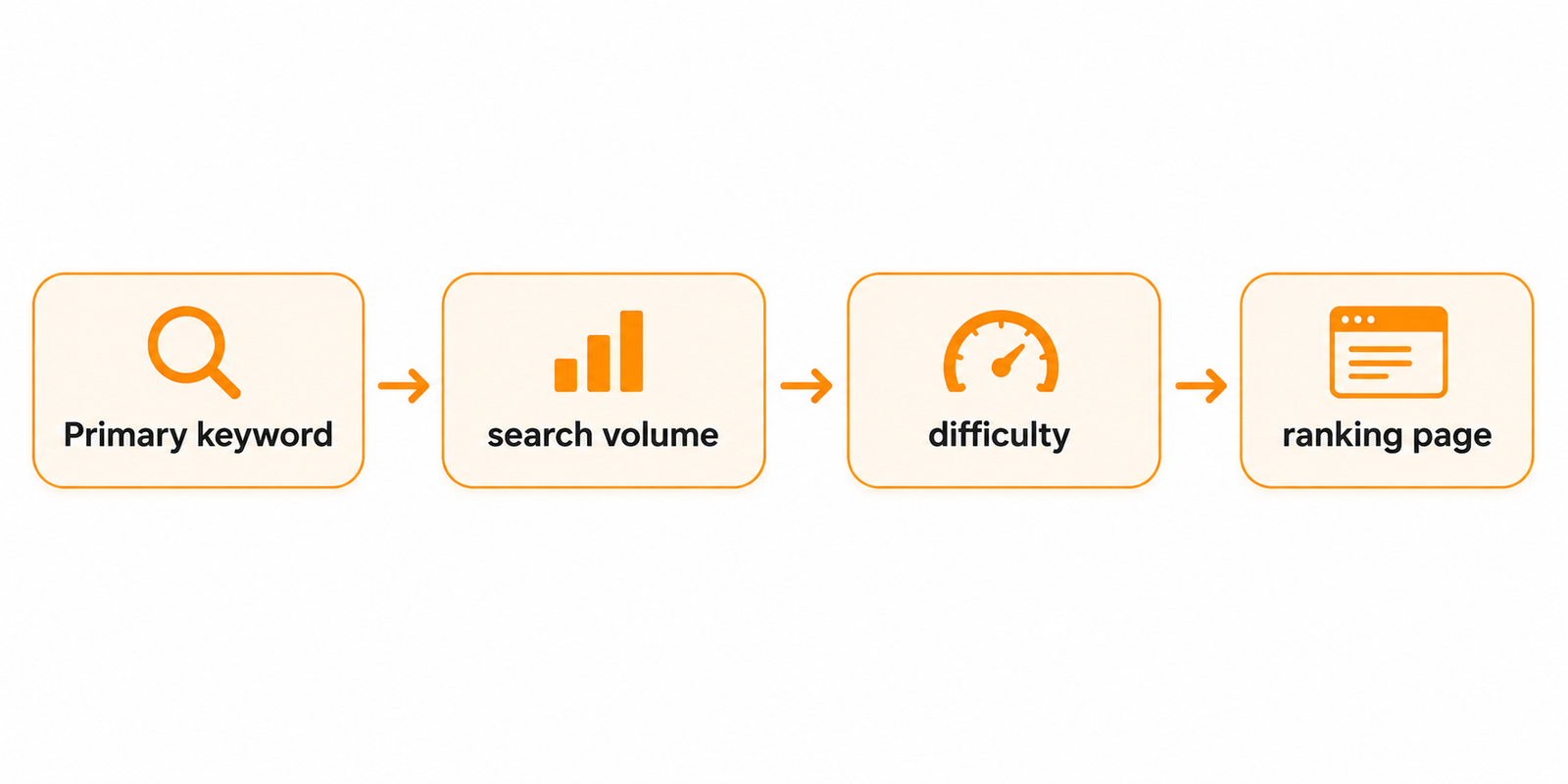
AI search introduces another layer:
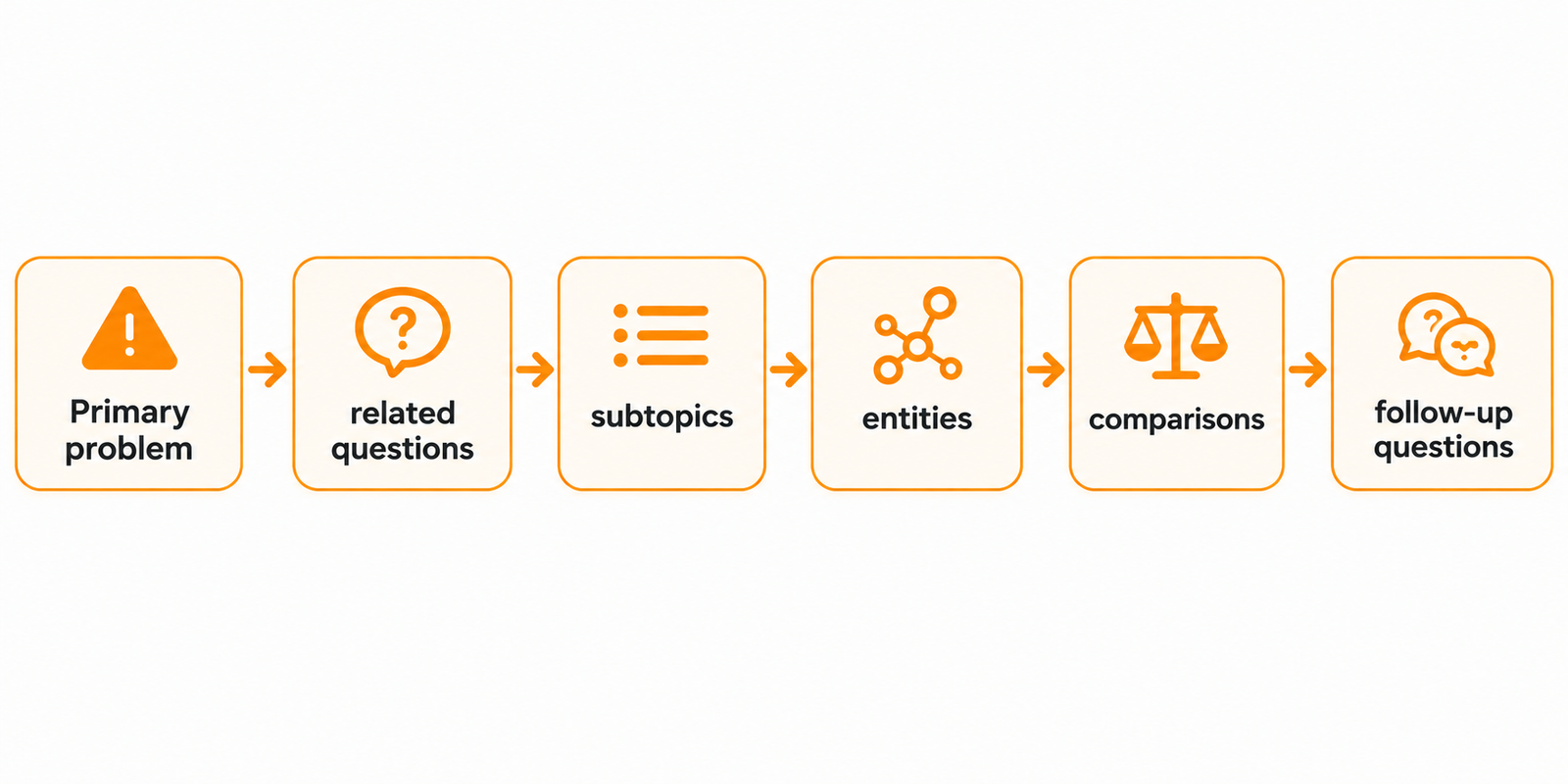
Google’s confirmed query fan-out approach makes this particularly important.
For example, a company targeting:
content writing services
should not build authority with one article alone.
Its surrounding content might address:
- what professional content writing includes
- content writing vs copywriting
- SEO content writing
- content writing costs
- how to hire a content writer
- human vs AI content
- content strategy
- content briefs
- E-E-A-T
- AI search optimization
- content ROI
- content marketing case studies
These pages should serve distinct user needs rather than exist as thin variations created solely to manipulate search.
Google specifically warns that mass-producing pages for every possible query or fan-out variation can violate its scaled-content abuse policies when done primarily to manipulate rankings.
The objective is therefore topical completeness without content inflation.
5. Build a Recognizable Brand Across the Web
Your website is only one source of information about your business.
Independent brand references can help AI systems understand:
who you are
what you specialize in
which subjects are associated with your business
how frequently credible external sources discuss you
Ahrefs analyzed 75,000 brands and found branded web mentions had correlations of approximately 0.66–0.71 with AI visibility across the platforms it studied. YouTube mentions showed an even stronger correlation of approximately 0.737. Ahrefs correctly notes that correlation does not establish causation.
Its updated Google AI Overview research also found that YouTube represented 5.6% of all cited AI Overview URLs in the analyzed dataset. Among cited pages that did not rank in Google’s top 100 for the direct keyword, 18.2% were YouTube URLs.
For businesses, this expands content strategy beyond the company blog.
Brand authority can develop through credible:
- industry publications
- guest interviews
- podcasts
- expert roundups
- YouTube videos and transcripts
- research citations
- conferences
- partner websites
- customer stories
- professional profiles
- relevant communities
Avoid purchasing or fabricating meaningless mentions. Google specifically warns against pursuing inauthentic mentions as an AI-search tactic.
AI Visibility Rule #5
Become known for a topic across the web instead of merely claiming expertise on your own website.
6. Strengthen E-E-A-T With Verifiable Experience
E-E-A-T refers to:
Experience
Expertise
Authoritativeness
Trust
It should not be treated as a decorative author box added after an article is written.
For content-led businesses, demonstrate experience throughout the page.
For example:
Instead of:
SEO content can improve traffic.
use a verified first-party observation such as:
Organic impressions increased from X to Y between [date] and [date] after we published 18 topic-cluster articles and refreshed 11 existing URLs. The numbers come from Google Search Console.
Then show the evidence.
Useful trust signals include:
- named authors
- detailed author profiles
- actual experience
- original screenshots
- methodology
- publication date
- updated date
- source citations
- editorial policy
- real company information
- case-study evidence
- correction policy where appropriate
Google supports Article structured data that can identify an article’s author, headline, images and publication information. It also supports ProfilePage markup for pages centered around a creator or organization.
Structured data does not guarantee an AI citation, and Google says no special schema is required for generative AI search.
Its proper role is to clarify information that genuinely exists on the page.
7. Use Evidence That Other Sources Can Verify
If you want AI systems to treat your page as a source, behave like a source.
Weak content says:
AI search is becoming extremely popular.
Source-worthy content says:
In Pew Research Center’s analysis of 68,879 Google searches, 18% generated an AI summary. For searches containing 10 or more words, that figure reached 53%.
Specific information is easier to evaluate and cite.
Whenever possible, use:
exact numbers
clear time periods
defined samples
named methodologies
primary sources
original research
documented experiments
Avoid statistics whose original source cannot be located.
Do not cite one blog that cites another blog that cites a third article whose original study has disappeared.
For changing statistics, show the date.
AI search is evolving too rapidly for an old number to be presented as permanent truth.
A useful example is AI Overview SERP overlap.
Ahrefs originally reported that roughly 76% of cited AI Overview pages appeared in the top 10. Its March 2026 re-analysis of approximately four million AI Overview URLs found that figure had dropped to around 38%.
Publishing the newer figure—and explaining the methodological change—is far more useful than repeating the older statistic because competitors continue to cite it.
8. Create Content for Humans Instead of Writing Robotically for AI
One of the biggest GEO misconceptions is that every article must be rewritten into repetitive 40-word blocks.
Google now explicitly says:
- there is no ideal page length for AI Search
- special “chunking” is unnecessary
- content does not need to be rewritten specifically for AI
- Google does not require special AI markup
- Google Search does not require llms.txt
- there is no special schema solely for AI Overviews or AI Mode.
That does not mean structure is irrelevant.
It means structure should improve comprehension rather than imitate what marketers think an LLM wants.
Use:
descriptive headings
short introductions
direct definitions
tables where comparison helps
ordered processes where sequence matters
examples
images
original charts
video
clear source attribution
Google specifically notes that high-quality images and video can provide additional opportunities for visibility in its generative Search experiences.
9. Measure AI Visibility Differently From Traditional SEO
Traditional SEO reporting usually tracks:
rankings
impressions
clicks
organic sessions
conversions
AI visibility requires additional metrics.
Track:
Metric | What It Tells You |
AI citations | How often your pages appear as sources |
Brand mentions | How often AI answers name your business |
Citation + mention rate | Whether attribution and brand recognition occur together |
AI referral traffic | Visits generated by AI platforms |
Cited URLs | Which pages are selected most often |
Prompt/topic visibility | Topics for which your brand appears |
Competitor share of voice | Who is being cited instead of you |
Assisted conversions | Leads influenced by AI discovery |
Google generative AI impressions | Search visibility inside Google’s generative features |
In June 2026, Google announced dedicated Generative AI performance reports in Search Console, including visibility in AI Overviews and AI Mode. The rollout initially began with a subset of websites rather than every property at once.
For ChatGPT, OpenAI says referral URLs include utm_source=chatgpt.com, allowing those visits to be identified in analytics.
Do not measure success only by clicks.
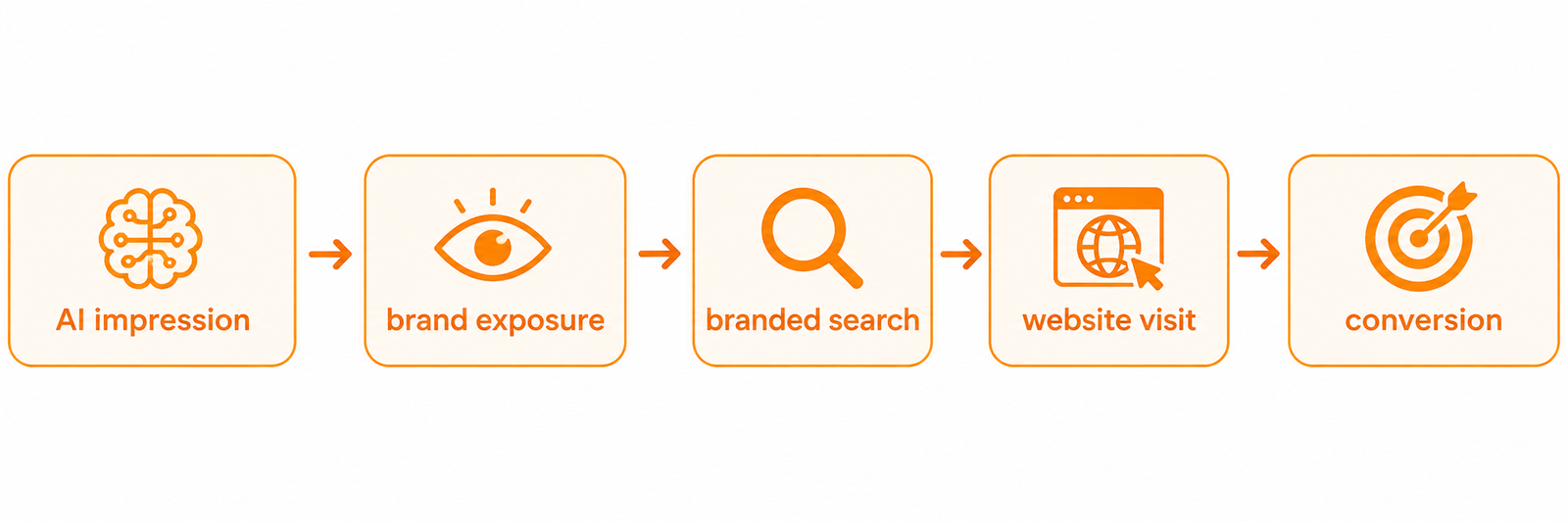
A user can discover your name in an AI response, search for your business later and convert through another channel.
Modern reporting therefore needs to connect:
What Makes Content More Likely to Be Cited by AI?
There is no universal AI citation formula.
However, the strongest evidence points toward a combination of:
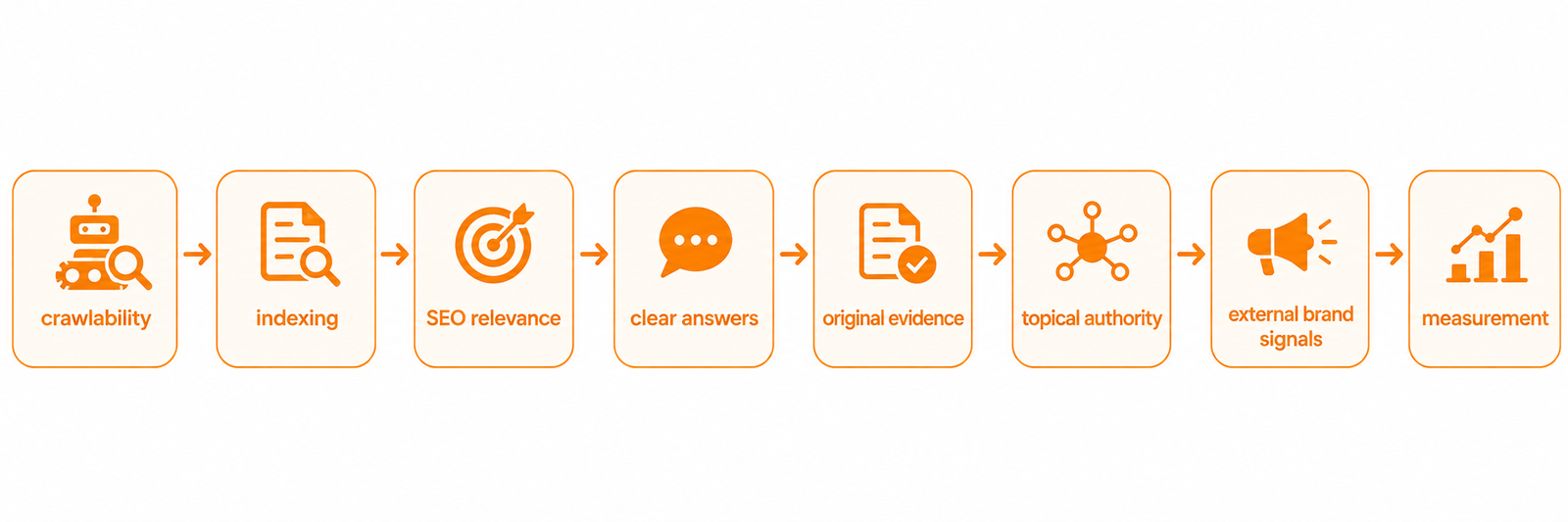
technical accessibility + strong search relevance + useful answers + original information + clear authorship + credible evidence + topical depth + external brand authority.
Google’s own guidance places particular emphasis on unique, expert-led and non-commodity content.
Semrush’s citation study found clarity, E-E-A-T, Q&A formatting and section structure positively associated with citations.
Ahrefs’ cross-platform research found web and YouTube brand mentions among the strongest correlates of AI brand visibility.
These findings collectively suggest that businesses should stop thinking of GEO as a formatting trick.
It is an authority and information-quality problem.
Seven Common AI Search Optimization Mistakes
1. Creating Hundreds of Generic AI Articles
Volume cannot substitute for usefulness.
Google explicitly warns against scaled content created primarily to manipulate rankings and recommends content that adds distinctive value.
2. Focusing Only on Traditional Rankings
Traditional ranking still matters, but Google’s query fan-out means useful supporting sources can come from retrieval paths beyond the direct SERP.
3. Treating GEO as a Schema Hack
Google says there is no special schema required for AI Overviews or AI Mode.
4. Creating an llms.txt File and Assuming the Job Is Done
Google Search says it does not use llms.txt as a generative Search ranking requirement.
5. Ignoring OAI-SearchBot
A site that wants content surfaced and cited in ChatGPT Search should not block OpenAI’s search crawler.
6. Publishing Statistics Without Original Sources
Unsupported statistics reduce trust and make content harder to verify.
Whenever possible, link directly to research methodology or the first-party organization publishing the data.
7. Measuring Only Traffic
AI discovery can happen before the click.
Track citations, brand mentions, referral traffic, branded searches and downstream conversions together.
A Practical SEO + AEO + GEO Framework for Businesses
Think of AI visibility as a six-layer system:
Layer | Objective | Example |
1. Access | Let systems discover the site | Googlebot and OAI-SearchBot access |
2. Indexing | Become retrievable | Indexed canonical URLs |
3. Relevance | Match user problems | Search-intent-led topic clusters |
4. Answers | Make information clear | Direct answers and useful sections |
5. Authority | Give systems reasons to trust you | Experience, evidence, citations, mentions |
6. Measurement | Identify what actually works | Search Console, analytics and AI visibility monitoring |
A business that skips layers one to three and begins with “GEO tricks” is optimizing the wrong end of the system.
How Should a Small Business Compete With Large Websites in AI Search?
Small businesses are unlikely to beat established publishers by producing more generic articles.
They can compete by producing more specific information.
A large marketing website can easily publish:
What Is Content Marketing?
A specialist can publish:
How We Structured 24 Articles Into 3 Topic Clusters and What Happened to Organic Impressions Over 180 Days
The second page has something the larger publisher may not have: proprietary experience.
That distinction matters because Google’s current guidance explicitly emphasizes unique viewpoints, first-hand experience and information that goes beyond commodity summaries.
Smaller brands should therefore compete on:
specificity
first-party evidence
specialization
original frameworks
transparent case studies
expert commentary
speed of updating information
—not generic publishing volume.
Does Your Business Need Separate SEO, AEO and GEO Strategies?
Usually, no.
You need one search visibility strategy with different execution layers.
SEO makes the content discoverable and competitive.
AEO makes the answer clear.
GEO makes the brand and information useful within generative retrieval and synthesis.
For Google specifically, this distinction has become even clearer. Google’s July 2026 guidance states that AEO and GEO are common industry terms but that, from Google’s perspective, optimization for its generative Search experience remains SEO.
Businesses should therefore avoid abandoning proven SEO practices because a new acronym becomes popular.
How Long Does It Take to Become Visible in AI Search?
There is no credible universal number.
Any company promising that your business will appear in ChatGPT or Google AI Overviews within an exact number of days is making a claim neither Google nor OpenAI guarantees.
Google explicitly states that meeting its requirements does not guarantee crawling, indexing or serving.
OpenAI similarly states that there is no way to guarantee top placement in ChatGPT Search.
The realistic objective is to improve the probability of retrieval and citation by strengthening:
crawlability
organic visibility
topic authority
information gain
brand mentions
source quality
content freshness
user satisfaction
The Future of Search Is Not SEO vs AI
AI search does not eliminate the need for strong content.
It makes generic content easier to replace.
The websites most exposed to AI search are those whose value stops at summarizing information that already exists elsewhere.
The businesses with a stronger opportunity are those that contribute something new:
data
experience
examples
research
tools
frameworks
proof
expert interpretation
That is the direction Google is explicitly encouraging with its emphasis on unique, valuable and non-commodity content.
The objective is no longer simply:
Write an article targeting a keyword.
A stronger objective is:
Become one of the best sources available for an entire business problem.
That approach can support traditional rankings, featured answers, Google AI Overviews, AI Mode, ChatGPT citations and—more importantly—real business authority.
automatically include utm_source=chatgpt.com, which can be tracked in analytics platforms such as Google Analytics.
Start with:
Google AI Overviews, AI Mode and ChatGPT may use different retrieval and ranking systems, so there is no single optimization switch that guarantees visibility across all of them.
But one principle survives every platform change:
The more original, verifiable and genuinely useful your business becomes as a source, the stronger its opportunity to earn visibility wherever people search for answers.
Frequently Asked Question
How can I make my business appear in Google AI Overviews?
Start with traditional SEO fundamentals. Your page must be indexed and eligible for Google Search. Build useful, original content around the questions your audience asks, strengthen technical accessibility, demonstrate experience and support claims with trustworthy evidence. Google’s generative Search systems use its core Search infrastructure together with retrieval and query fan-out.
How can I get my website cited by ChatGPT?
OpenAI recommends ensuring that OAI-SearchBot is not blocked from content you want discovered and surfaced in ChatGPT Search. Beyond crawler access, create relevant, reliable and distinctive information that can legitimately support an answer. No method guarantees a ChatGPT citation.
Is GEO replacing SEO?
No. GEO describes optimization aimed at visibility in generative answers, but Google explicitly states that SEO best practices remain foundational for its generative Search features.
What is AEO?
Answer Engine Optimization focuses on making information useful for direct-answer experiences. It normally involves understanding questions, answering them clearly and organizing supporting information logically. AEO overlaps heavily with modern SEO and GEO.
Do I need special schema for Google AI Overviews?
No. Google says there is no special schema.org markup required to appear in AI Overviews or AI Mode. Standard structured data can still be useful for traditional Search features when it accurately reflects visible page content.
Does llms.txt improve Google AI Overview rankings?
Google states that it does not use llms.txt as a special mechanism for Search or its generative AI capabilities. Maintaining one for another service will neither improve nor hurt Google Search visibility by itself.
Do pages have to rank in Google's top 10 to appear in AI Overviews?
No. Ahrefs’ March 2026 study of approximately four million AI Overview URLs found that about 37% of cited URLs appeared in the top 10 organic results for the same query. Around 36.7% did not appear in the top 100 standard blue-link results for that direct query. Google’s query fan-out can retrieve supporting sources through related searches.
Does longer content get more AI citations?
Not necessarily. Google says there is no ideal page length for generative AI Search. Ahrefs separately reported an approximately 0.04 correlation between word count and AI citations in its analysis. Content should be as long as necessary to satisfy the user’s intent without adding irrelevant sections merely to increase word count.
Are backlinks enough to improve AI visibility?
No. Backlinks can contribute to traditional authority, but AI visibility involves broader brand signals. Ahrefs’ study of 75,000 brands found branded web mentions correlated more strongly with AI visibility than several traditional authority metrics, while YouTube mentions showed one of the strongest correlations in its dataset. These findings show correlation rather than causation.
How can I measure traffic from ChatGPT?
OpenAI says ChatGPT Search referral links automatically include utm_source=chatgpt.com, which can be tracked in analytics platforms such as Google Analytics.

Piyush Sethia
Co-Founder | Content Marketer and Strategist
Recognised as the 2026 Tally MSME Business 'Tech Transformer' Award winner, Piyush Sethia leverages advanced tech facilities to transform content marketing and writing efficiency. With over a decade of experience, he specializes in data-backed content marketing, AIO, GEO, SEO strategy, and organic growth blueprints. He is also the author of The Clarity of Confusion, showcasing his unique ability of storytelling and simplifyinig complex landscapes into crystal-clear narratives. His expertise lies in converting technical data and deep audience insights into engaging, search-optimized strategies that drive sustainable traffic.
No Responses