
Seeing your Google Search Console impressions increase should feel like progress. But what happens when the graph keeps moving upward while clicks barely change?
It usually means Google is finding reasons to show your pages, but users are not finding enough reason to choose them.
High impressions and low clicks can result from weak titles, mismatched search intent, poor rankings, generic content, outdated information, stronger competitors or changes in how search results are presented.
The solution is therefore not always: “Publish more blogs.” Sometimes the better decision is to improve the content already earning visibility.
What Does “High Impressions but Low Clicks” Mean?
An impression is recorded when your page appears in Google Search results. A click is recorded when someone clicks through to your website. Click-through rate, or CTR, is calculated by dividing clicks by impressions.
Google Search Console therefore helps answer an important question: when people see your website in search results, how often do they choose it?
High impressions are not automatically bad. They can mean you already have an opportunity. The real question is why that visibility is not becoming traffic.
1. Your Page Is Appearing, but It Is Ranking Too Low
Your page may generate thousands of impressions because it appears for many queries, but if it usually sits far down the search results, comparatively fewer users will click it.
Check Search Console for:
average position
individual queries
clicks
impressions
CTR
device
country
page
Do not evaluate only the website-wide average. One page may be in position 3 for one query and position 36 for another.
What should you do?
Identify queries where the page is genuinely relevant, impressions are meaningful, positions are within realistic striking distance, and the search intent matches your business. Then determine whether the page needs deeper content, better intent alignment or stronger supporting authority.
2. Your SEO Title Does Not Give Users a Reason to Click
Ranking gets you seen. Your title helps get you selected.
Compare “Content Marketing Tips” with “Why Your Content Marketing Gets Traffic but No Leads: 9 Problems to Fix.” The second title makes the problem and expected outcome much clearer.
Review your title against four questions:
Does it clearly explain the subject?
Does it match the searcher’s problem?
Does it provide a meaningful reason to click?
Does the actual article fulfil what the title promises?
Avoid adding sensational claims simply to increase CTR. A click that immediately becomes a disappointed visit does not improve the usefulness of the page.
3. Your Search Intent Is Wrong
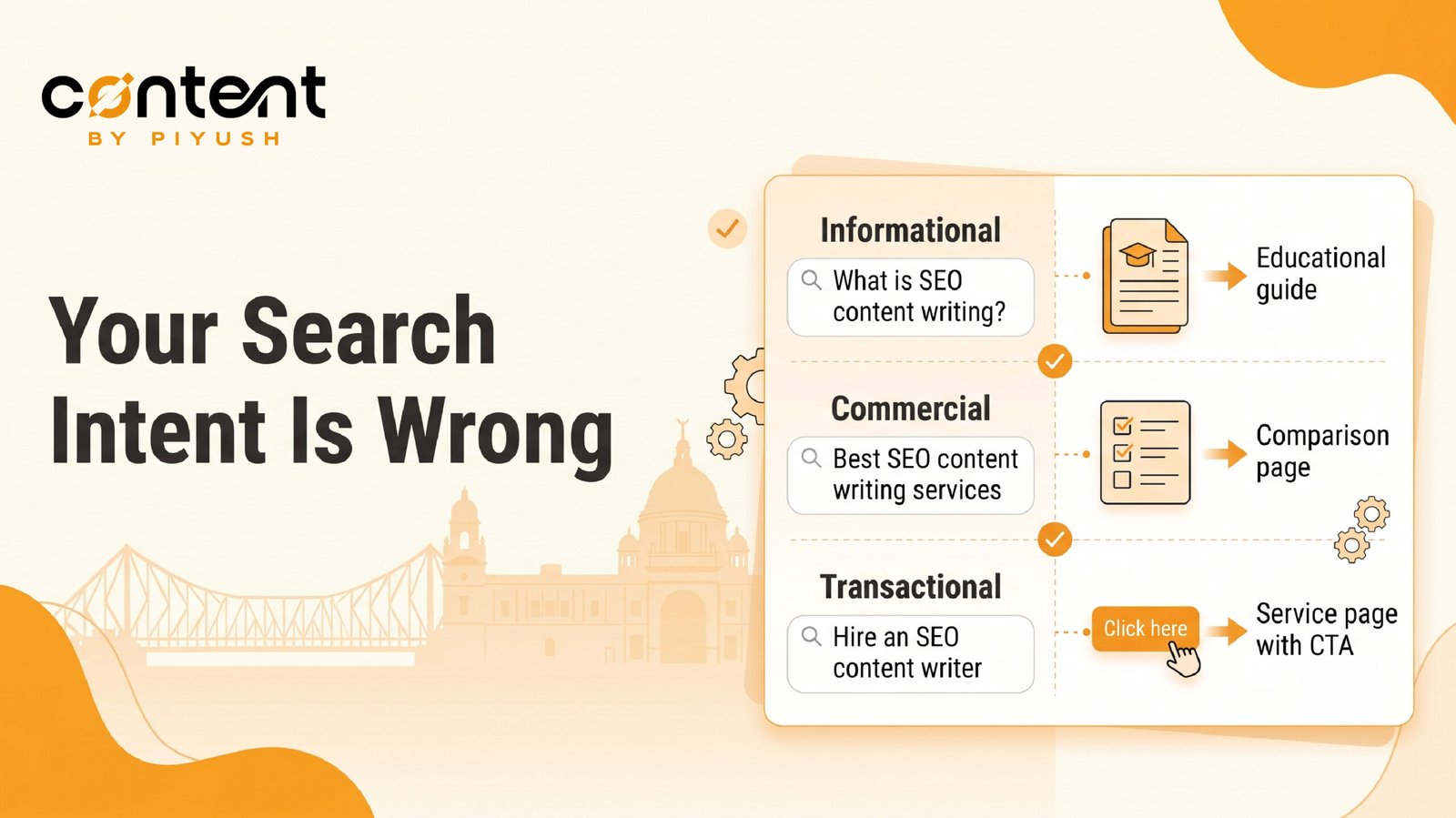
A page can contain the correct keyword and still provide the wrong answer.
Someone searching “SEO content writing services India” is probably evaluating a provider. If your page spends 1,500 words explaining only “What is SEO content writing?”, the content may technically relate to the keyword but fail its commercial intent.
Likewise, someone searching “what is SEO content writing?” probably does not want an aggressive sales page.
Search intent should determine article format, depth, headings, examples, CTA and page type.
4. Your Content Looks Too Similar to Everything Else
Searchers often see multiple pages saying roughly the same thing: create quality content, know your target audience, use keywords, post consistently.
These statements are not necessarily wrong. They are simply easy to find everywhere.
Ask: what does your page contribute that the searcher could not get from ten competing pages?
Useful differentiation can include original examples, real case studies, first-hand observations, screenshots, before-and-after results, original frameworks, expert opinions, pricing analysis and proprietary data.
This is also why the 500 to 18,000 case study is valuable: it provides specific evidence rather than another generic claim that “content helps SEO.”
5. Your Introduction Takes Too Long to Answer the Question
Many SEO articles begin with several paragraphs explaining why the topic is important. The searcher already knows why it matters. That is usually why they searched.
Why Is My Website Getting Impressions but No Clicks?
Your website may be appearing in Google for relevant queries without earning clicks because its ranking position, title, search-intent match or perceived usefulness is weaker than competing results. Start by checking the affected queries, pages, positions and CTR in Search Console before deciding whether to rewrite, refresh or create new content.
This answer-first structure helps users immediately understand the point and creates a self-contained passage that answer systems can interpret more easily.
6. Your Page Has Become Outdated
A page that performed well two years ago may slowly lose competitiveness.
Check whether it contains obsolete statistics, old screenshots, discontinued tools, outdated recommendations, old pricing, broken links, stale examples or changed AI-search information.
Refreshing an existing page can sometimes be more valuable than publishing another URL targeting substantially the same intent.
7. You Are Targeting Broad Keywords Without Answering Specific Questions
A broad article about content marketing may compete across many interpretations. A specific article about why content marketing generates traffic but no qualified leads addresses a defined business problem.
Problem-led content can naturally capture long-tail questions such as “Why is my website traffic not converting?”, “Why are my blogs not generating leads?”, “Should I hire a content marketing agency?” and “Do I need a content strategist?”
8. Your Page Has No Clear Evidence of Expertise
A company can claim “We are experts.” But that is not the same as showing expertise.
Strengthen important pages with named authors, relevant author biographies, direct experience, documented methodologies, client examples, credible sources, transparent limitations and case studies.
For Content by Piyush, this means connecting strategic articles to real examples such as traffic growth and keyword-growth case studies where the data can be verified.
9. Your Internal Links Do Not Help the Reader Move Forward
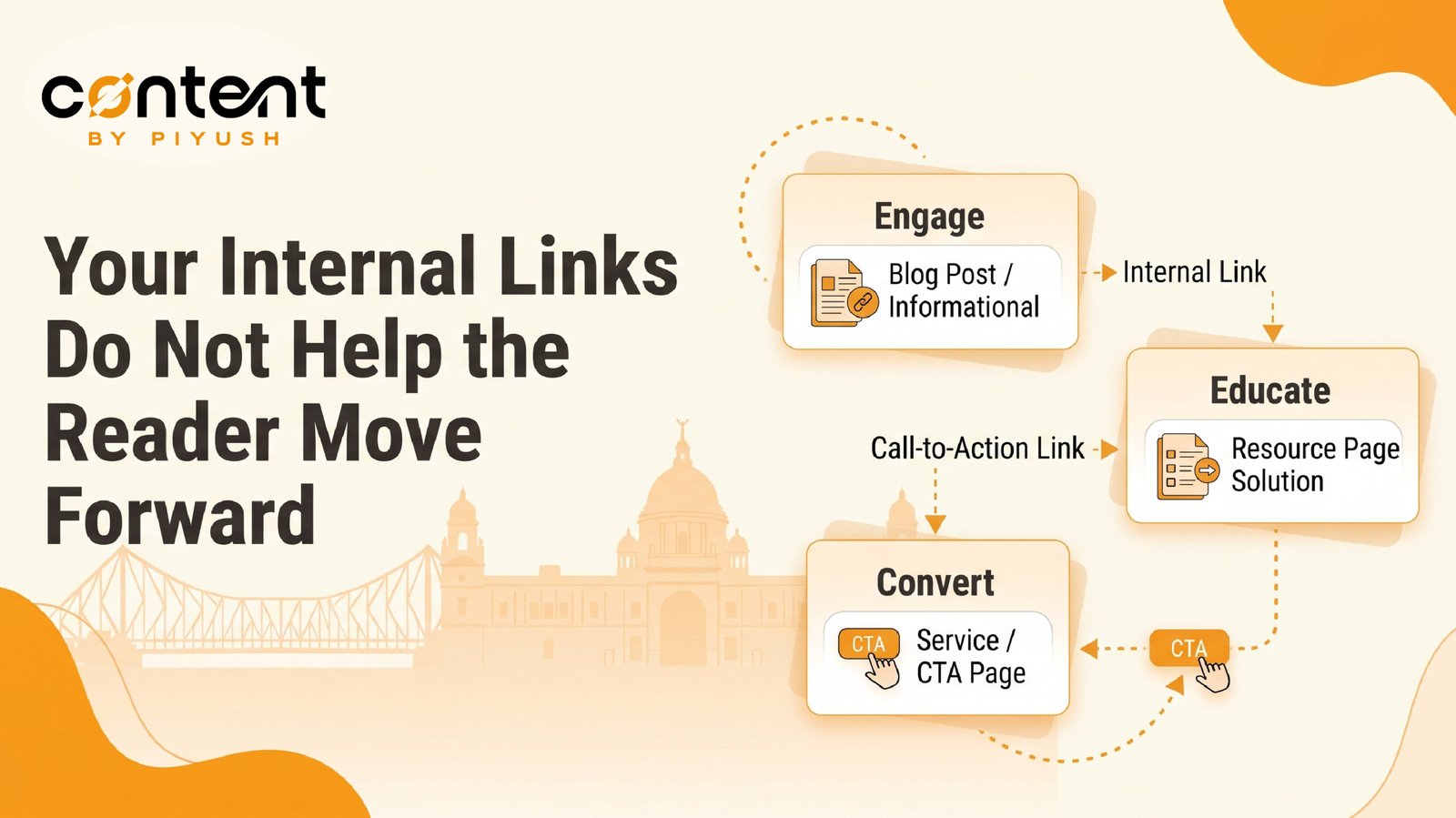
A blog may answer a problem perfectly but then leave the reader with nowhere meaningful to go.
A visitor reading this article may naturally ask: should I update the page, do I need a content audit, or should I hire an SEO content writer?
The logical next step is Content Audit vs New Content. If the audit reveals a writing or optimization gap, the reader can then move to SEO Content Writing Services or Content Strategy Services.
Internal links should represent a logical next question, not simply an SEO checklist.
10. Search Results Are Changing
Organic search is no longer only a list of ten blue links. Users may encounter AI Overviews, images, videos, featured elements, forums, business results, shopping results and traditional organic links.
The right response is not to abandon SEO. It is to strengthen SEO, AEO and GEO together.
SEO makes the page discoverable and relevant. AEO makes important answers clear and easy to understand. GEO makes the page useful enough to act as a trustworthy source.
Can a Content Marketing Agency Fix High Impressions but Low Clicks?
Yes, but only after diagnosing the reason. An agency or content strategist should not immediately recommend “more blogs.”
A proper review should examine query-level impressions, CTR, current positions, search intent, titles, content quality, outdated information, internal linking, competitive gaps and commercial relevance.
From there, each page can be classified as Keep, Refresh, Expand, Consolidate, Reposition or Replace.
When Should You Hire an SEO Content Expert?
Consider external assistance when important pages have visibility but low CTR, traffic has plateaued, writers are producing content without SEO strategy, several articles compete for the same intent, you do not know which pages to update, service pages have little supporting content, or SEO, AEO and GEO are being treated as disconnected activities.
The objective should be to improve the content system, not simply increase word count.
Final Takeaway
If Google is giving your website impressions, there may already be demand around your content. Do not immediately respond by publishing more.
First identify where the impressions come from, why searchers are not clicking, and whether the existing page deserves improvement.
Sometimes the fastest content opportunity is not creating something new. It is making an existing page substantially more useful.
Need Help Understanding Why Your Content Gets Visibility but Not Traffic?
Content by Piyush can review your existing content, search intent, topic coverage and content gaps to determine what should be refreshed, consolidated or created next.
Explore Content Strategy Services or SEO Content Writing Services.

Piyush Sethia
Co-Founder | Content Marketer and Strategist
Recognised as the 2026 Tally MSME Business 'Tech Transformer' Award winner, Piyush Sethia leverages advanced tech facilities to transform content marketing and writing efficiency. With over a decade of experience, he specializes in data-backed content marketing, AIO, GEO, SEO strategy, and organic growth blueprints. He is also the author of The Clarity of Confusion, showcasing his unique ability of storytelling and simplifyinig complex landscapes into crystal-clear narratives. His expertise lies in converting technical data and deep audience insights into engaging, search-optimized strategies that drive sustainable traffic.
No Responses