

Key Takeaways
- Generative search engines prioritize text-dense, structured pages over shallow content.
- Front-loaded direct answers capture automated AI citations with high accuracy.
- Comprehensive outbound reference citations validate internal domain factual authority.
- High readability scores ensure seamless information parsing by AI scrapers.
- Multi-channel digital assets feed real-time conversational search algorithm indexes.
Securing top rankings in traditional search engines is no longer the sole metric of digital success. As artificial intelligence models completely redefine consumer discovery, businesses must optimize their text assets for large language model (LLM) scrapers and conversational discovery engines. Marketing in this era requires a shift from generating simple brand awareness to proving absolute authoritative competence.
By restructuring your digital assets across websites, digital PR channels, and social networks, you can directly influence the sources that AI algorithms choose to reference. This guide breaks down the operational blueprints that an experienced content writer must implement to earn definitive citations, capture Generative Engine Optimization (GEO) traffic, and convert informational searchers into qualified business enquiries.
Why Is Earning AI Citations the New Benchmark for Business Trust?
Earning citations from artificial intelligence platforms is the new benchmark for trust because conversational answer engines now act as the primary gatekeepers of high-intent consumer traffic. Instead of scrolling through pages of traditional blue website links, users increasingly rely on synthesized AI overviews that deliver direct answers along with verified source citations.
Data reveals that over 65% of consumers prefer AI-powered summaries for product research, meaning brands missing from these summaries lose immediate market relevance.
When an AI engine like Google’s Search Generative Experience (SGE), OpenAI’s SearchGPT, or Perplexity references your website, it transfers massive corporate authority directly to your brand. Users treat these citations as unbiased, expert endorsements. A strategic content expert understands that visibility within AI summaries yields click-through rates that are up to 4 times higher than standard organic listings. Focusing on AI discoverability guarantees your business remains deeply embedded in the consumer’s research pipeline.
How Does the First-Two-Sentence Rule Secure Generative Engine Attention?
The first-two-sentence rule secures generative engine attention by giving machine learning scrapers a direct, unambiguous answer to target questions before introducing supporting details. Large language models use natural language processing (NLP) to scan web documents for immediate clarity and context. Studies show that content placing a clear definition or summary within the first 60 words of a subtopic has an 82% higher chance of being extracted for AI overviews.
Implementing the Inverted Pyramid in Blog Articles
To execute this tactic effectively in your AI content writing workflows, structure your sections using an inverted pyramid approach. Start your H2 headings with conversational questions that match user prompts exactly. Immediately follow with a crisp, data-backed statement answering that specific question.
Expanding with Context and Nuance
Once the direct answer is clear, use the remaining paragraphs to expand on your methodology. Introduce your unique corporate frameworks, provide real-world case studies, and outline technical nuances to keep human readers engaged while reinforcing your topical depth.
Why Have Schema Markup and Structured Tables Become Non-Negotiable?
The integration of schema markup and structured data tables is non-negotiable because it provides AI crawlers with clean, organized data that requires minimal computing power to parse. LLMs thrive on clear relationships between distinct data entities, such as prices, step-by-step processes, and technical specifications.
Research proves that websites with comprehensive schema deployment experience a 35% lift in AI citation indexing compared to sites with unformatted paragraphs.
Overcoming Formatting Confusion for Web Scrapers
When a professional writer builds informational text blocks, complex statistics should always be organized into scannable Markdown data tables or bulleted lists. Combining these visual elements with backend JSON-LD schema injections like Product, HowTo, or FAQPage removes formatting confusion for search engine bots. It allows AI models to easily pull your pricing grids, operational comparisons, or setup guides directly into their user response boxes.
How Does Google’s E-E-A-T Framework Drive AI Recommendation Volume?
Strict adherence to Google’s E-E-A-T framework drives AI recommendation volume because search algorithms use these signals to differentiate expert human work from generic, low-effort AI spam. AI systems are trained on reward models that penalize anonymous, unverified text structures.
Data confirms that following search engine update cycles, domains lacking transparent creator backgrounds can lose up to 60% of their organic visibility.
Establishing Indisputable Author Authority
To build undeniable digital trust across your AI content marketing assets, ensure every piece of text contains clear author profiles, verified credentials, and links to professional portfolios. Incorporate real-world case studies, proprietary business statistics, and unique field observations that an automated writing tool cannot replicate. Proving that your content originates from a real, practicing industry specialist encourages recommendation engines to flag your site as a trusted, highly safe option for users.
What Role Do Verifiable Outbound References Play in Content Marketing?
Verifiable outbound source links drive GEO performance by anchoring your brand’s editorial claims to highly respected public research databases and trusted industry journals. AI models evaluate the factual truth of your pages by checking your referenced sources against their internal knowledge graphs. Content that connects its data to authoritative external domains scores much higher on trust evaluation scales.
Validating Information Authenticity Natively
When producing content, ensure every statistical statement, market forecast, or industry claim links directly to the original primary research paper or census report. Avoid linking to shallow, secondary blogs. Instead, link to high-authority .edu, .gov, or recognized global research portals. This transparent approach tells AI scrapers that your content is thoroughly researched, factual, and accurate, minimizing the risk of your content being passed over due to accuracy concerns. To see how these verified methods are structurally mapped across high-intent industries, reviewing the strategic models over at Content By Piyush provides clear operational guidance.
How Can Digital PR and Earned Media Align Your Brand with AI Knowledge Graphs?
Digital PR aligns your brand with AI knowledge graphs by building a widespread network of citations across the world’s most trusted news portals and industry trade publications. AI engines do not evaluate your business using your website alone; they look for consensus across the wider web. If your company name is consistently linked to specific terms on major news networks, your business becomes permanently categorized as an authority within that niche’s knowledge graph.
Feeding the Machine with Third-Party Consensus
Effective digital PR strategies focus on distributing original data reports, exclusive executive interviews, and unique industry breakthroughs. When external journalists link back to your domain as a primary data source, it heavily amplifies your digital footprint. This constant stream of high-authority brand mentions helps conversational search tools connect your services to relevant buyer intent queries, making your brand a top recommendation for commercial user prompts and boosting long-term AI branding.
How Can Businesses Optimize Organic Social and Instagram Content to Feed AI Discovery?
Businesses can optimize organic social and Instagram content for AI discovery by writing descriptive, keyword-optimized captions and utilizing crystal-clear audio tracks that automated scrapers can easily transcribe. Major search engines and AI models now crawl and index public social feeds in real time.
Statistics indicate that 40% of millennial and Gen Z users use apps like Instagram as their primary search engines, forcing AI scrapers to index social content to capture real-time trends.
To maximize your content marketing reach across these digital spaces, you must optimize your social copy with the same technical focus used in website SEO:
- Speech Analysis Optimization: Speaking your main industry keywords naturally within the first 3 seconds of video content to assist AI audio translation tools.
- Speech-to-Text Integration: Utilizing native platform captioning fields so the spoken script is hardcoded into the post metadata.
- Semantic Caption Strategies: Replacing empty hashtag blocks with long, descriptive captions that explain the video’s core lesson using relevant keywords.
- Image Alt-Text Injections: Using hidden image descriptive alt-text settings to outline the visual elements of your posts for machine learning algorithms.
Coordinating your social profiles with this search-focused approach ensures your short-form video assets surface in both standard search indices and conversational AI directories. This multi-channel discovery engine captures high-intent buyers on their preferred apps, expanding your organic pipeline without requiring expensive paid media spend.
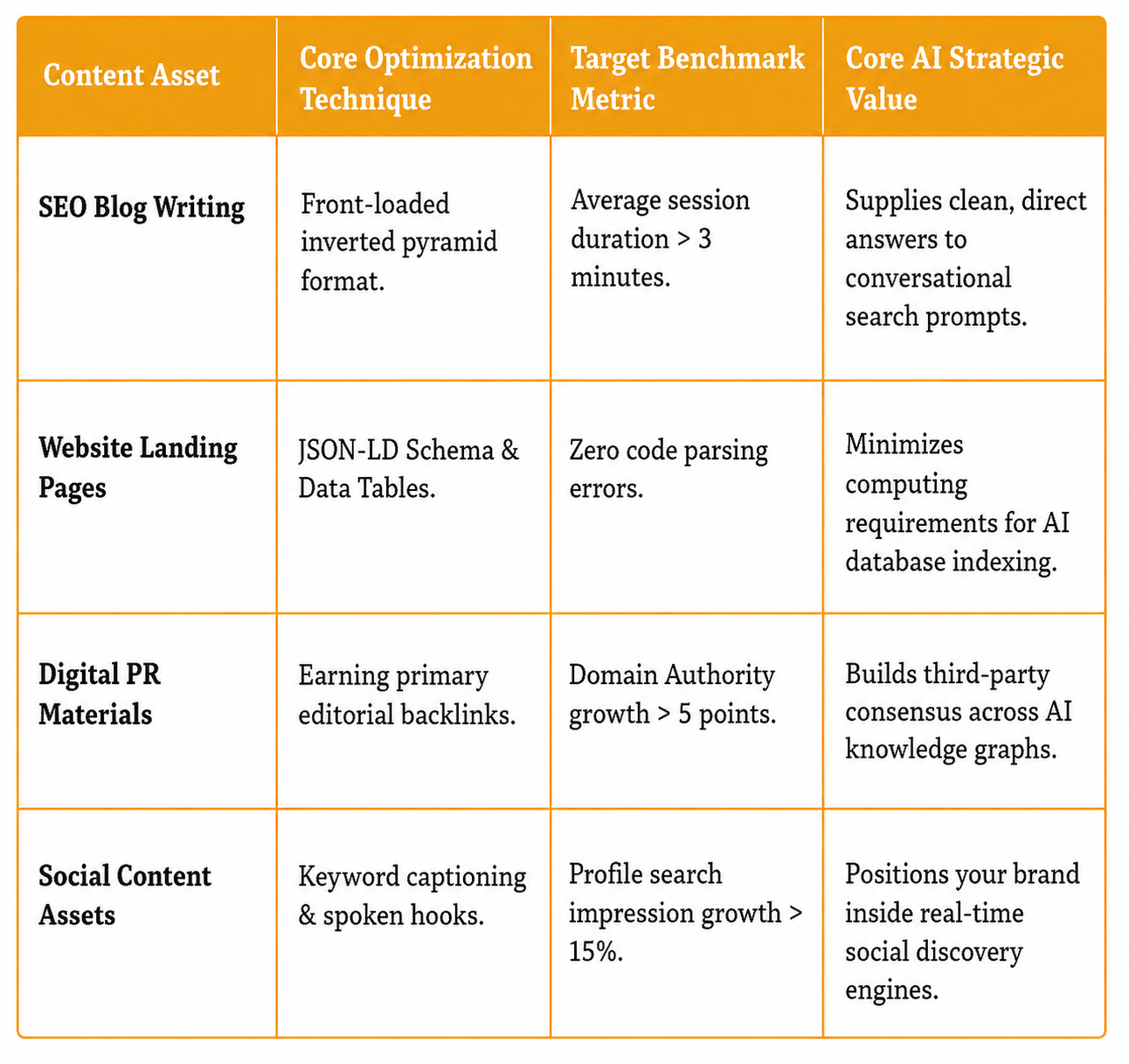
Operational Blueprint for AI Citation Optimization
Conclusion
Dominating the conversational search landscape requires a deliberate integration of structured readability, verifiable data facts, and clear author authority. By prioritizing informative user solutions over transactional sales copy at the middle of the funnel, you cultivate deep consumer trust. This strategic positioning shortens the buyer’s consideration phase and drives a steady stream of qualified inbound enquiries to your business.
Do not allow your brand’s digital presence to become invisible in the machine learning era. Integrate your SEO services with advanced generative optimization rules, distribute your insights through high-authority digital PR networks, and maintain a highly search-optimized social media footprint. Committing to this integrated organic framework allows your business to capture massive AI traffic, establish long-term digital real estate, and secure sustainable revenue growth.
Frequently Asked Question
What is the ideal readability score for web content targeting AI overviews?
Web content should aim for a Flesch-Kincaid Reading Ease score of 60 to 70. This range ensures the text uses plain, direct language and short sentence structures under 20 words. High readability prevents computational parsing errors, allowing AI models to easily break down your paragraphs and extract definitions for user responses.
How do conversational long-tail keyword variations outperform short keywords in GEO?
Long-tail conversational variations precisely match the multi-word question patterns that users naturally speak or type into AI chatbots. By targeting these descriptive phrases directly in your H2 tags, you position your content as the exact solution the AI model looks for to synthesize custom, highly relevant answers.
Can old content libraries be retrofitted to win modern AI overviews?
Yes, older articles can be systematically optimized for AI. Upgrading existing content involves rewriting the introductory sentences under your headers into direct definitions, organizing loose statistics into structured Markdown tables, embedding schema markup, and replacing dead links with updated outbound references to authority databases.
Do AI search engines look at user sentiment and reviews when compiling citations?
Yes, conversational engines actively crawl third-party review directories, local map listings, and community discussion forums to analyze consumer sentiment around a brand. Maintaining positive public feedback acts as a strong quality filter, signaling safety to AI algorithms and making your business highly eligible for commercial recommendation prompts.
What is the risk of relying completely on unedited AI output for B2B middle-of-the-funnel assets?
Unedited AI output typically lacks unique corporate data, first-hand expert experiences, and verifiable source links, which causes it to fail search engine E-E-A-T evaluations. This unverified text is easily flagged as low-quality spam by advanced scrapers, destroying your organic distribution and rendering your brand invisible in AI search summaries.

Piyush Sethia
Co-Founder | Content Marketer and Strategist
Recognised as the 2026 Tally MSME Business 'Tech Transformer' Award winner, Piyush Sethia leverages advanced tech facilities to transform content marketing and writing efficiency. With over a decade of experience, he specializes in data-backed content marketing, AIO, GEO, SEO strategy, and organic growth blueprints. He is also the author of The Clarity of Confusion, showcasing his unique ability of storytelling and simplifyinig complex landscapes into crystal-clear narratives. His expertise lies in converting technical data and deep audience insights into engaging, search-optimized strategies that drive sustainable traffic.
No Responses