
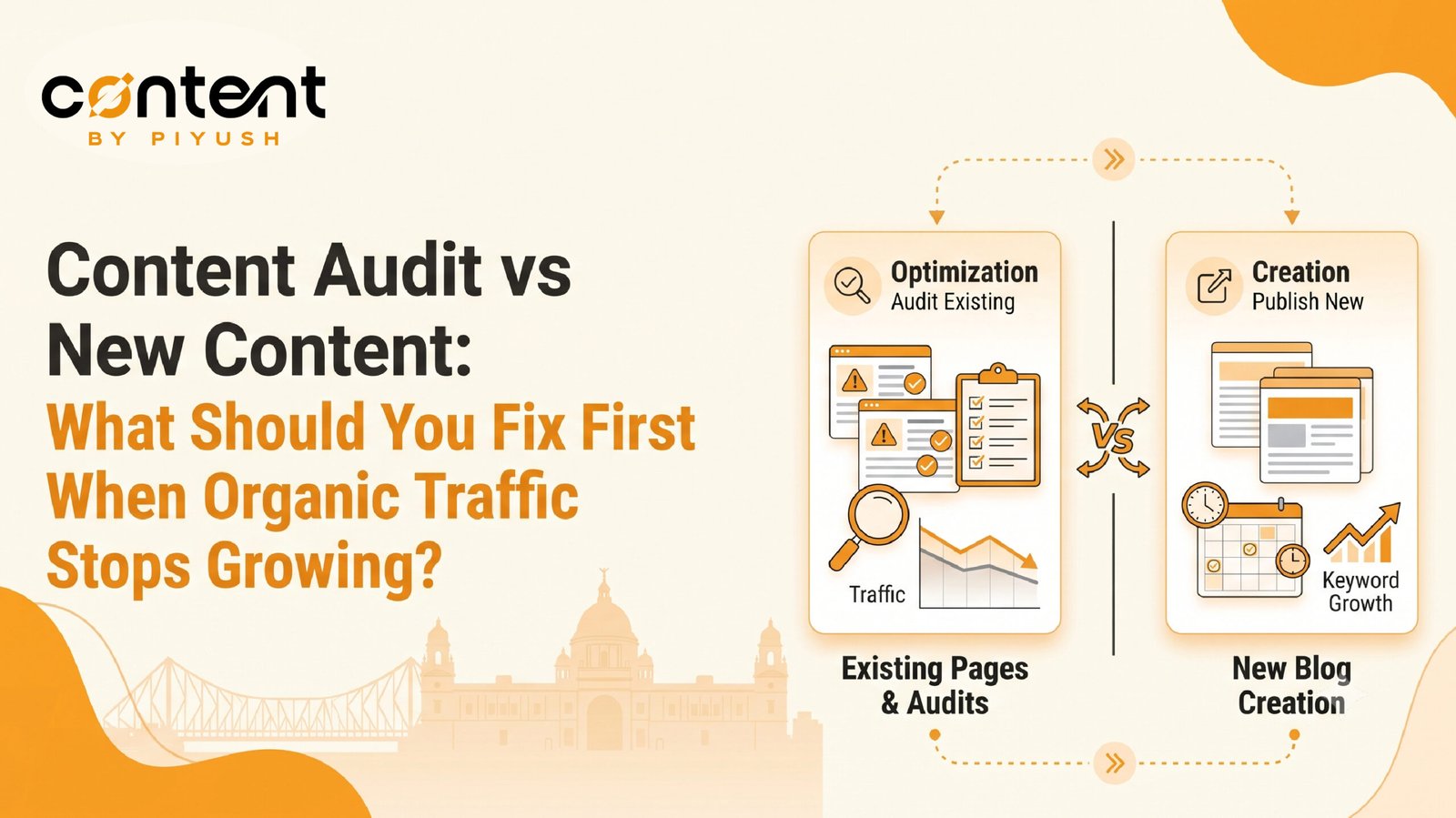
When organic traffic slows down, the common reaction is: “We need more content.” Sometimes that is correct. But sometimes the website already has enough pages and needs something very different: better content.
A content audit helps identify what your existing pages are doing before you invest in creating more of them.
The right decision is rarely content audit OR new content. It is usually: audit first, then decide where new content is actually needed.
What Is an SEO Content Audit?
An SEO content audit is a structured review of the pages already published on a website to determine which content should be kept, improved, consolidated, redirected or replaced.
A useful audit can evaluate:
- organic clicks
- impressions
- CTR
- ranking queries
- search intent
- conversions
- backlinks
- freshness
- topic coverage
- internal links
- duplicate intent
- content quality
- E-E-A-T signals
- AI-search citations where measurable
The objective is not to create a spreadsheet containing every URL. It is to make better decisions about what happens next.
What Is the Difference Between a Content Audit and New Content Creation?
Content Audit | New Content |
Reviews existing pages | Creates new URLs |
Finds outdated content | Covers missing topics |
Finds cannibalization | Targets new intent |
Identifies declining pages | Expands topical authority |
Improves internal links | Supports new clusters |
Finds content worth consolidating | Captures new buyer questions |
Protects existing authority | Creates future authority |
The strongest content strategy uses both.
7 Signs You Need a Content Audit Before More Blogs

1. Organic Traffic Has Stopped Growing
If you have published consistently but performance has plateaued, producing another ten articles without understanding the existing problem may simply increase the size of the problem.
Start with Search Console. Look for pages trending down, queries losing clicks, important pages with growing impressions but weak CTR, pages with similar queries and content that previously performed well.
If impressions are rising while clicks are weak, read Why Is Your Website Getting Google Impressions but Not Enough Clicks? before deciding what to create next.
2. You Have Multiple Articles About Nearly the Same Topic
Four different pages about “SEO content writing” may be necessary if the intent genuinely differs. But if they answer the same question, they may dilute clarity and internal authority.
A content audit identifies where consolidation makes more sense than expansion.
3. Older Blogs Still Receive Impressions
If an old article continues to earn impressions, Google is still finding reasons to surface it.
Instead of replacing it, ask whether the information is current, whether search intent has changed, whether competitors now answer new questions, whether important internal links are missing, and whether unsupported claims should be removed.
4. Your Blog Gets Traffic but Service Pages Do Not
This often indicates an architecture problem. You may have TOFU content without MOFU + BOFU + service-page connections.
A content audit should therefore review not just individual articles but how content moves visitors through the site.
For example: Why Is Your Content Marketing Getting Traffic but Not Generating Qualified Leads? can lead to How to Build a TOFU–MOFU–BOFU Content Funnel, then to the Best Content Marketing Agency in India guide, and finally to Content Strategy Services.
5. You Cannot Explain What Each Article Is Supposed to Achieve
Ask this for every strategic URL: why does this page exist?
A useful answer might be: captures a specific informational query, supports a service page, addresses a sales objection, demonstrates expertise, earns citations, compares solutions, or generates leads.
“Because the keyword had search volume” is not enough.
6. Important Content Is Outdated
Priority refresh categories often include AI, software, pricing, regulations, statistics, platform features, market data and search-engine changes.
Do not simply update the publication date. Update the information that actually changed.
7. You Do Not Know Which Content AI Systems Are Using
Traditional SEO measurement remains important. But visibility can now include citations inside AI-generated answers.
Bing Webmaster Tools’ AI Performance reporting can show citations, cited pages, grounding queries, topics, intents and citation share. ChatGPT Search visibility also requires basic crawl accessibility; publishers who want public content discoverable should make sure OAI-SearchBot is not blocked.
How Should You Audit Content for SEO, AEO and GEO?
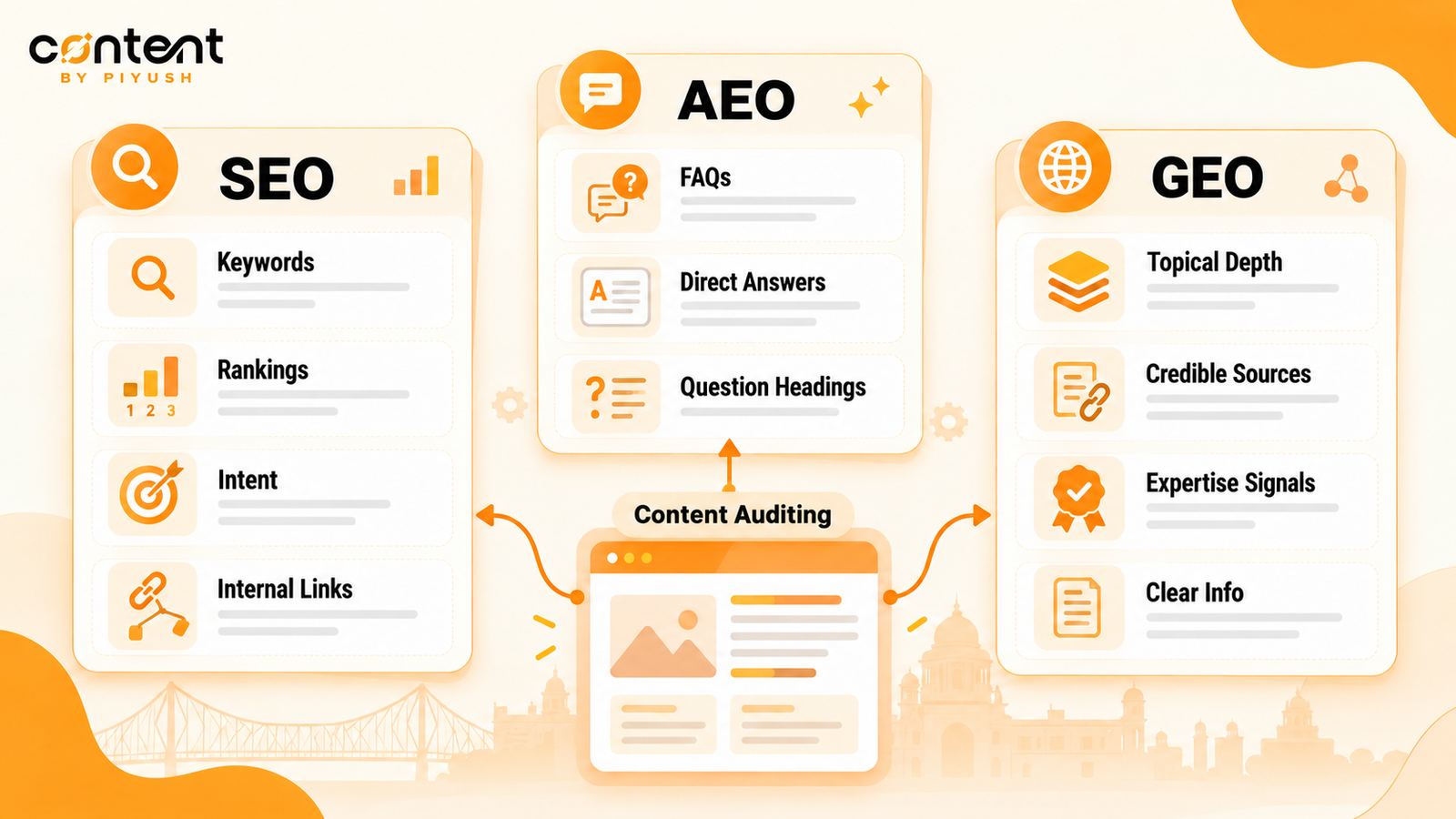
Do not create three separate audits. Use one framework.
Layer 1 — SEO
Review indexing, clicks, impressions, queries, position, backlinks, internal links, intent and topic overlap.
Layer 2 — AEO
Ask whether the page answers important questions directly, whether key definitions can stand on their own, whether headings are descriptive, and whether important facts are buried in long introductions.
Layer 3 — GEO
Ask whether the information is source-worthy, whether claims are supported, whether the page adds original information, whether authorship is clear, whether entities are unambiguous and whether the content is current.
The overlap is substantial. Better information architecture helps all three.
Keep, Refresh, Consolidate, Redirect or Create?
KEEP
Use when the page performs well, information remains current, intent is clear and no major gaps exist.
REFRESH
Use when impressions remain strong, content has become outdated, rankings are slipping, competitors now cover the subject better or missing questions can be added.
CONSOLIDATE
Use when several pages target the same intent, information is fragmented or one stronger resource would be clearer.
REDIRECT
Use when a page no longer serves a useful standalone purpose or its content has been merged elsewhere.
CREATE
Use when an important buyer question has no appropriate page, a new commercial intent is missing, a topic cluster has a genuine gap or a service page lacks supporting content.
When Should You Create New Content?
New content is justified when the website cannot satisfy a valuable search intent with an existing URL.
Examples include SEO content writing services India, content marketing agency vs freelancer and why content marketing gets traffic but no leads. Trying to force all of these into one enormous page would make the experience less focused.
Should You Update Old Blogs or Publish New Ones?
Update the existing page when the intent is fundamentally the same, the page already has impressions or rankings, the URL has useful backlinks, the subject remains relevant and missing information can be added naturally.
Create a new page when the user intent is meaningfully different, the existing article cannot satisfy it cleanly, a new service or commercial opportunity exists, or a distinct stage of the buyer journey needs coverage.
How Often Should Businesses Audit Their Content?
There is no universal schedule. A practical approach is ongoing monitoring for major traffic changes, quarterly reviews of commercially important clusters, and a broader strategic review every 6–12 months.
Fast-moving AI-search content may need more frequent attention than evergreen foundational topics.
Should You Hire a Content Strategist to Audit Your Website?
You may benefit from external support if your team keeps creating content but cannot explain what drives results, organic traffic has plateaued, you have hundreds of existing pages, keyword cannibalization is suspected, service pages receive little support, or you need SEO + AEO + GEO considered together.
A professional audit should result in priorities, not merely observations.
What Should a Professional SEO Content Audit Include?
A useful provider should review performance data, search intent, content quality, keyword overlap, topical coverage, internal linking, conversion paths, E-E-A-T and AI visibility where measurable.
If the audit shows that writing quality, intent alignment or missing topic coverage is the core problem, SEO Content Writing Services may be the next step.
Final Takeaway
When organic traffic stops growing, publishing more content is not automatically the solution.
First understand what you already own. A good content audit answers: what is working, what is declining, what should be improved, what should be consolidated, and what is genuinely missing?
Only then should the next content calendar be built.
Unsure Whether You Need New Content or Better Existing Content?
Content by Piyush can help review your current content, search intent, topic clusters and commercial gaps before another publishing cycle begins.
Explore Content Strategy Services or SEO Content Writing Services.

Piyush Sethia
Co-Founder | Content Marketer and Strategist
Recognised as the 2026 Tally MSME Business 'Tech Transformer' Award winner, Piyush Sethia leverages advanced tech facilities to transform content marketing and writing efficiency. With over a decade of experience, he specializes in data-backed content marketing, AIO, GEO, SEO strategy, and organic growth blueprints. He is also the author of The Clarity of Confusion, showcasing his unique ability of storytelling and simplifyinig complex landscapes into crystal-clear narratives. His expertise lies in converting technical data and deep audience insights into engaging, search-optimized strategies that drive sustainable traffic.
No Responses