
Key Takeaways
E-commerce search is moving from simple keyword matching toward conversational product discovery.
Google says its generative Search systems combine traditional Search quality systems with retrieval-augmented generation and query fan-out. Its current guidance specifically recommends that e-commerce businesses provide accurate product information through Merchant Center and structured data.
ChatGPT has also expanded product discovery. OpenAI says ChatGPT can use product information, pricing, reviews and other merchant data when deciding which products to surface. Shopify merchant catalogs are already integrated into ChatGPT through Shopify Catalog, while other merchants can provide product information through emerging product-feed infrastructure.
For e-commerce and D2C brands, this means:
- Ranking product pages is no longer the only objective.
- Product data needs to be complete and machine-readable.
- Category and collection pages need genuine decision-making value.
- Editorial content should cover discovery, evaluation and purchase questions.
- Product attributes, use cases and differentiators need to be explicit.
- Original reviews, customer evidence and expert guidance matter.
- Brand visibility outside your own website is increasingly important.
- AI citations, product appearances and brand mentions need separate measurement.
- SEO, AEO and GEO should operate as one connected commerce strategy.
The brands that become easiest to understand, compare, verify and recommend have the strongest opportunity to gain visibility in both traditional search and AI-assisted shopping.
Why E-commerce Search Strategy Has Changed in 2026
A shopper looking for running shoes once searched:
best running shoes
Then opened several results.
Today, the same shopper may ask:
I run 5 km four times a week, have mild overpronation, prefer extra cushioning and want shoes under ₹8,000. Which options should I consider?
That single query contains:
- product category
- intended use
- frequency
- physical requirement
- preferred feature
- budget
- purchase intent
AI search systems can research multiple aspects of that question before generating an answer.
Google describes this process as query fan-out, where an AI-driven query can trigger several related searches to gather enough information to answer a complex question.
For retailers, that changes SEO from:
Which keyword does this product rank for?
to:
Across how many relevant shopping situations can Google or an AI system confidently understand and recommend this product?
That is a much bigger opportunity.
AI Is Moving Deeper Into Commercial Search
AI-generated search results are no longer limited to educational queries.
Semrush studied more than 600,000 keywords across 10 industries between November 2025 and April 2026. It found that the occurrence of Google AI Overviews on commercial-intent search results increased by an average of 71% during the six-month period.
Google has responded by introducing commerce-specific AI reporting.
Its Merchant Center AI Performance Insights now measures how brands appear across conversational shopping queries on AI Mode and AI Overviews.
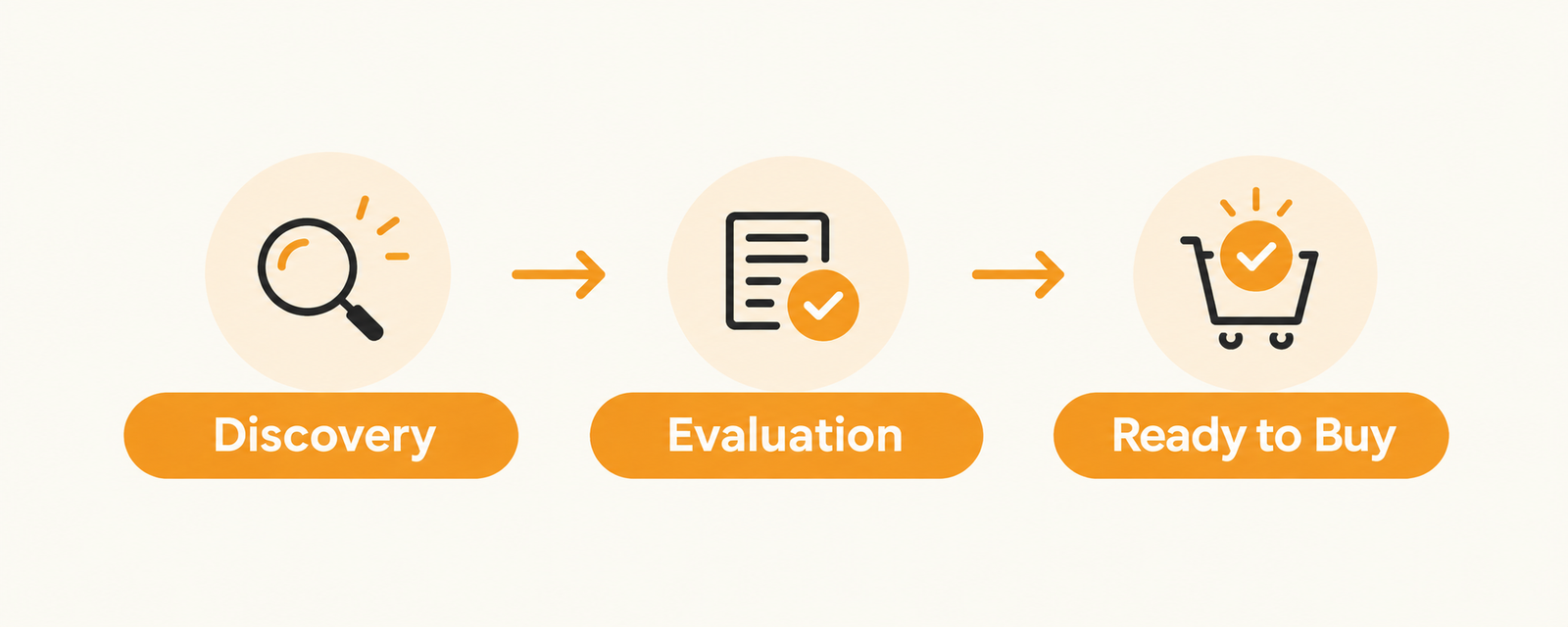
Google separates these queries into three shopping stages:
- Discovery
- Evaluation
- Ready to buy
That framework is extremely useful for e-commerce content strategy.
Instead of creating hundreds of disconnected blog posts, build content around the buyer’s movement through these three stages.
What Is E-commerce AI SEO?
E-commerce AI SEO is the process of making an online store, its products and its supporting content easy for traditional search engines and AI-powered discovery systems to find, understand, compare and surface to shoppers.
It combines:
SEO
To improve crawling, indexing, rankings and organic visibility.
AEO
To provide clear answers to shopper questions.
GEO
To improve the likelihood of your brand or information being retrieved, cited or recommended by generative AI systems.
Product-data optimization
To communicate prices, availability, attributes, reviews, variants, shipping and product specifications in structured formats.
For Google, however, GEO should not be treated as a replacement for SEO.
Google’s current guidance states that AI Overviews and AI Mode remain rooted in its existing Search ranking and quality systems.
A practical e-commerce formula is therefore:
Technical SEO + Product Data + Search Intent + Useful Content + Brand Authority = Stronger Search and AI Discovery
E-commerce SEO vs AEO vs GEO
Area | Main Question | Example |
SEO | Can Google find and rank my product? | silk saree online |
AEO | Can my page directly answer the shopper’s question? | Which silk saree is best for summer weddings? |
GEO | Can an AI system retrieve or recommend my product/brand? | Recommend breathable silk sarees under ₹10,000 for a daytime wedding |
Product Data | Can the system understand exactly what I sell? | Price, color, material, stock, size, reviews |
Brand Authority | Does the wider web validate my brand? | Reviews, mentions, press, creators, expert references |
Businesses need all five.
The 2026 AI Search Framework for E-commerce & D2C Brands
A strong strategy can be built around eight interconnected layers.
1. Build an Accurate Product Data Foundation
For e-commerce brands, product information is no longer merely page copy.
It is data.
Google recommends sharing product information through both:
- Product structured data on product pages
- Google Merchant Center product feeds
Google says these mechanisms can increase eligibility for richer product appearances and help its systems better understand details such as pricing, availability and shipping.
Google also supports merchant listing information such as:
- price
- availability
- shipping
- return information
- product ratings
- variants
- sizes
- colors
- material
Product data fields worth prioritizing
Product Information | Example |
Product name | Pure Banarasi Tissue Silk Saree |
Brand | Brand name |
Category | Women’s Sarees |
Material | Pure silk |
Color | Red |
Size | Standard |
Price | ₹12,500 |
Availability | In stock |
SKU | SBS-101 |
GTIN | Where applicable |
Ratings | Genuine customer rating |
Reviews | Genuine customer reviews |
Shipping | Delivery information |
Return policy | Return conditions |
Product variants | Color/size variations |
A product should not force an AI system to infer whether something is cotton, silk, vegan, waterproof or compatible with a certain device when that information can be stated explicitly.
Important
Structured data should reflect information actually visible and accurate on the page.
Do not add attributes purely to manipulate search systems.
2. Stop Writing Thin Product Descriptions
One of the biggest e-commerce content problems is manufacturer-style copy.
For example:
Premium-quality handbag made from excellent materials. Perfect for every occasion.
That description tells neither a shopper nor an AI system very much.
A useful product page should answer:
- What exactly is it?
- Who is it for?
- What is it made from?
- What makes it different?
- When should it be used?
- What size is it?
- What problem does it solve?
- What are its limitations?
- How should it be maintained?
- What alternatives exist?
Imagine a shopper asking:
Which lightweight women’s office bag can fit a 14-inch laptop and survive daily commuting?
A product page should contain enough verified information for that question to be answered without guesswork.
Better product content
Instead of:
Spacious premium office tote.
Use:
The tote includes a padded compartment designed for laptops up to 14 inches, two internal accessory pockets and a zippered main compartment. The empty bag weighs approximately 780 grams.
Specific facts create retrieval opportunities.
Generic adjectives do not.
3. Optimize Around Product Attributes, Not Just Keywords
Conversational shopping introduces a crucial SEO change:
Shoppers increasingly search through attributes and constraints.
Examples include:
- under ₹5,000
- waterproof
- cotton
- lightweight
- suitable for sensitive skin
- for small rooms
- compatible with iPhone
- cruelty-free
- machine washable
- for beginners
- available in size XXL
Google’s AI Performance Insights specifically reports popular attributes that consumers include in conversational searches. It can also identify attributes missing from merchants’ product data.
That makes attribute completeness a strategic SEO issue.
Traditional keyword model
running shoes
Conversational attribute model
lightweight cushioned running shoes for flat feet under ₹7,000
One product can potentially become relevant to hundreds of query combinations when its attributes are accurately represented.
This is why e-commerce SEO teams should build an attribute taxonomy for each product category.
For fashion, that might include:
- material
- weave
- color
- occasion
- season
- pattern
- fit
- care
- craftsmanship
- region
- price band
For electronics:
- processor
- storage
- battery
- display
- compatibility
- ports
- dimensions
- weight
- warranty
- use case
Attributes create the vocabulary AI systems need to understand products.
4. Turn Category Pages Into Decision Pages
Many e-commerce category pages consist of:
H1 + two generic sentences + 60 product cards
That may be enough for navigation.
It is rarely enough for complex product discovery.
A stronger category page can contain:
Short category definition
Explain what the category contains.
Who it is for
Describe likely buyers and use cases.
Important differences
Help shoppers understand variants.
Buying considerations
Explain what to consider before selecting a product.
Relevant attributes
Material, sizing, application, compatibility or other important characteristics.
FAQs
Answer genuine category-level questions.
Product links
Connect information directly to relevant products.
The aim is not to insert 2,000 words below every collection grid.
Google explicitly warns against creating excessive search-focused content simply to manipulate rankings.
Add content only where it improves the shopping decision.
5. Build Content Around the Three AI Shopping Stages
Google now provides an unusually useful framework for structuring e-commerce content.
Its Merchant Center AI reporting divides conversational shopping queries into:
Your content strategy should do the same.
Stage 1: Discovery
The shopper is still understanding the problem.
Examples:
Which saree material is best for summer weddings?
What type of mattress is good for back sleepers?
Which skincare ingredients work for oily skin?
Recommended content:
- educational guides
- trend reports
- beginner guides
- problem-solution content
- use-case guides
Stage 2: Evaluation
The shopper knows the category and compares options.
Examples:
Tissue silk vs organza saree
Memory foam vs latex mattress
Vitamin C vs niacinamide
Recommended content:
- comparison articles
- buying guides
- product comparisons
- alternatives
- pros and cons
- expert recommendations
- product-use guides
Stage 3: Ready to Buy
The shopper has strong transaction intent.
Examples:
buy tissue silk saree under ₹15,000
best queen latex mattress with 10-year warranty
niacinamide serum for oily skin under ₹1,000
Recommended pages:
- product pages
- collections
- category pages
- offer pages
- product comparison pages
- shipping/returns information
6. Create Product Comparison Content AI Can Use
AI shopping systems are naturally suited to comparison.
OpenAI describes shopping research as an experience designed for decisions involving comparisons, trade-offs and multiple constraints.
This makes comparison content particularly important.
Consider publishing content such as:
Product A vs Product B
Silk vs Cotton
Option A vs Option B: Which Is Better for Beginners?
Top 7 Products for [Specific Use Case]
Best Products Under ₹X
But avoid creating fake “best” articles designed solely to place your own product first.
Useful comparisons should show meaningful criteria.
Criterion | Product A | Product B |
Material | X | Y |
Weight | X | Y |
Best for | X | Y |
Price | X | Y |
Maintenance | X | Y |
Main advantage | X | Y |
Limitation | X | Y |
The limitation row is important.
Real buying advice includes trade-offs.
Marketing copy pretends every product is perfect.
AI systems helping users compare products need the former.
7. Treat Reviews as Search Data, Not Decoration
Customer reviews contain a type of information brands struggle to manufacture:
real-world product experience.
A buyer may say:
The dress looked great but the sleeves felt tight.
or:
The battery lasted almost two full working days for me.
These experiences help future shoppers understand products beyond specifications.
Google supports review and AggregateRating structured data when guidelines are followed. Reviews displayed through structured data must represent genuine content available to users, and Google explicitly prohibits fake or undisclosed incentivized reviews.
OpenAI also says its shopping experiences may summarize public product reviews when helping users evaluate options.
Encourage reviews that naturally answer:
- What did you use the product for?
- What did you like?
- What did you dislike?
- How did the size/fit perform?
- Was it worth the price?
- Who would you recommend it to?
Never script positive answers.
The value comes from authenticity.
8. Build Content That Adds Information Beyond the Product Catalog
This is where D2C brands can outperform marketplaces.
A marketplace may have more products.
A specialist brand can have more knowledge.
Google’s July 2026 generative Search guidance strongly emphasizes unique, expert-led, non-commodity content rather than information easily reproduced from existing webpages.
For an apparel brand, original information could include:
- how a textile is produced
- artisan interviews
- fabric tests
- styling experiments
- wash-care testing
- regional history
- product photography
- design process
- fit observations
- customer use cases
For skincare:
- formulation explanations
- ingredient sourcing
- dermatologist commentary
- usage testing
- patch-test guidance
For furniture:
- material tests
- load capacity
- assembly demonstrations
- room-size guidance
- dimensions
- durability observations
The principle is simple:
Your website should know more about your products than a generic AI-generated article does.
9. Create Topic Clusters Around Commercial Questions
Keyword-by-keyword blogging often produces isolated content.
AI search favors a broader approach because conversational queries frequently trigger multiple related retrievals.
Google has confirmed that AI Mode and other generative Search experiences can use query fan-out to conduct multiple related searches.
Suppose a brand sells silk sarees.
Do not stop at:
silk saree
Build a topic ecosystem.
Core category
Silk Sarees
Educational cluster
- Types of silk sarees
- How to identify pure silk
- Silk saree care
- Silk sarees for weddings
Comparison cluster
- Banarasi vs Kanjivaram
- Tissue silk vs organza
- Silk vs silk-blend sarees
Commercial cluster
- Best silk sarees for weddings
- Silk sarees under ₹10,000
- Lightweight silk sarees
Expertise cluster
- How silk sarees are woven
- Artisan techniques
- Authenticity guide
- Fabric glossary
Conversion pages
- collections
- individual products
- bridal collection
- festive collection
Then connect them intelligently through internal links.
This gives both humans and retrieval systems a coherent subject structure.
10. Optimize Product Images and Video
AI shopping is increasingly visual.
OpenAI’s March 2026 shopping update expanded visual browsing, product comparison and image-driven discovery inside ChatGPT.
Google also explicitly recommends high-quality image and video content as part of its generative Search optimization guidance.
For e-commerce products, include:
- high-resolution primary images
- alternative angles
- close-up details
- scale/context images
- product-in-use images
- short demonstration video
- proper descriptive alt text
- descriptive image filenames where appropriate
Fashion brands can show:
- fabric close-ups
- drape
- border
- blouse design
- front/back views
- daylight appearance
Furniture brands can show:
- dimensions
- room context
- storage configuration
- assembly
Beauty brands can show:
- texture
- packaging
- application
- ingredient labels
A 600-word description cannot communicate everything an image can.
11. Ensure ChatGPT Can Discover Your Store
Googlebot is not the only crawler relevant to AI commerce.
OpenAI recommends allowing OAI-SearchBot for pages merchants want discoverable and surfaced in ChatGPT Search.
OpenAI’s product-discovery ecosystem has also expanded through the Agentic Commerce Protocol.
As of 2026, OpenAI states that merchants including Target, Sephora, Nordstrom, Best Buy, Lowe’s, The Home Depot and Wayfair have integrated product discovery through ACP infrastructure.
Shopify product data is already integrated through Shopify Catalog for participating Shopify merchants.
This is significant because AI commerce is progressing beyond:
AI gives advice → shopper goes to Google
toward:
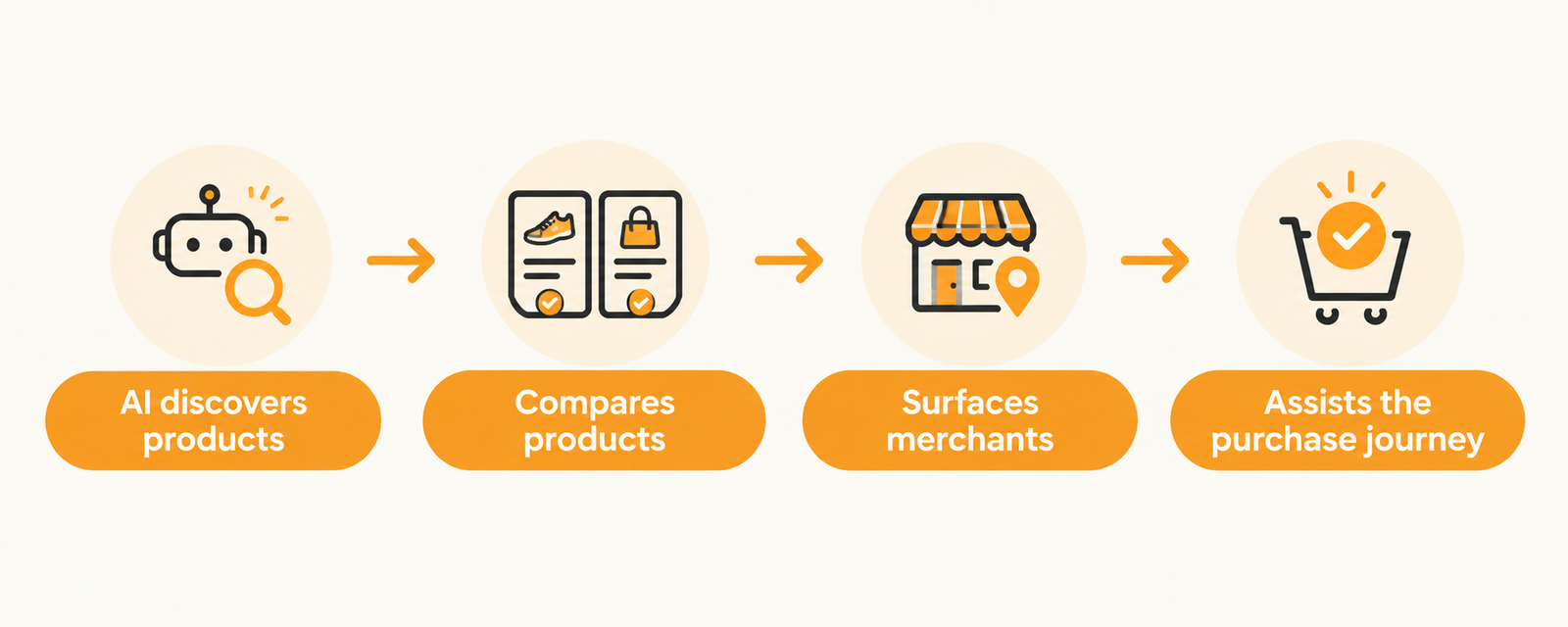
E-commerce technical teams should therefore monitor AI-commerce feeds and protocols in addition to normal SEO infrastructure.
12. Build Brand Authority Outside Your Website
A D2C brand should not exist only on its own domain.
AI systems can use information from many sources when forming recommendations.
Build legitimate presence through:
- independent product reviews
- creator coverage
- YouTube
- editorial publications
- customer discussions
- industry sites
- social channels
- podcasts
- press coverage
- partner websites
This is not a recommendation to manufacture mentions.
Google specifically discourages pursuing artificial or inauthentic mentions as a GEO tactic.
Instead, produce things worth discussing:
research
distinctive products
original designs
strong customer experiences
expert insights
useful tools
data
stories
A brand becomes easier to recommend when its reputation is corroborated beyond its own marketing copy.
What Content Should an E-commerce Brand Create for AI Search?
Use this content matrix.
Buyer Need | Best Content Format | Example |
Learn | Educational guide | What Is Tissue Silk? |
Explore | Category guide | Types of Silk Sarees |
Compare | Comparison | Tissue Silk vs Organza |
Decide | Buying guide | Best Saree for Summer Weddings |
Validate | Reviews/case study | Customer Experience |
Understand product | Product page | Detailed SKU page |
Find options | Collection page | Wedding Silk Sarees |
Resolve doubt | FAQ | How Do I Wash Tissue Silk? |
Trust brand | About/process | How Our Sarees Are Made |
Buy | Product/collection | Shop Tissue Silk Sarees |
This creates coverage across the entire buying journey without producing multiple pages for the same search intent.
What Should an AI-Ready Product Page Include?
Use the following framework.
Product identity
- clear product name
- brand
- category
- SKU/identifier
Core product facts
- materials
- dimensions
- size
- color
- weight
- compatibility
- relevant specifications
Commercial information
- price
- stock
- delivery
- returns
- warranty
Decision information
- best use cases
- who it suits
- limitations
- important differences
- care instructions
Evidence
- genuine reviews
- ratings
- product images
- demonstration video
- expert/testing information where relevant
Machine-readable information
- Product schema
- Offer
- availability
- ratings where eligible
- product variant markup
- Merchant Center feed
The best product page should simultaneously work for:
the shopper
AI retrieval
commerce feeds
without sounding written for a machine.
The Biggest E-commerce GEO Mistakes to Avoid
Mistake 1: Publishing AI-Written Product Descriptions at Scale
Changing a few adjectives across 5,000 SKUs does not create useful information.
Unique products require unique information.
Mistake 2: Treating GEO as an llms.txt Trick
Google explicitly says there is no special AI text file such as llms.txt required for its generative Search features.
Technical gimmicks cannot replace valuable product information.
Mistake 3: Ignoring Merchant Center
Google specifically recommends Merchant Center feeds to improve its understanding of e-commerce inventory.
Mistake 4: Incomplete Product Attributes
A product may be perfect for a conversational search but remain difficult to identify if critical attributes are missing.
Mistake 5: Publishing Generic Buying Guides
An article called:
10 Best Shoes
with no testing, comparison method or expertise adds little value.
Explain:
- selection criteria
- intended user
- trade-offs
- evidence
- why each option was chosen
Mistake 6: Creating Hundreds of Near-Duplicate Pages
Avoid generating one page for every tiny keyword variation.
Google continues to warn against scaled content produced primarily to manipulate rankings.
Mistake 7: Hiding Useful Information Inside Images
Price charts, specifications or comparison data should not exist only inside an image.
Keep important information available as crawlable text as well.
How to Measure E-commerce AI Search Visibility
Measurement has improved considerably in 2026.
Google Merchant Center’s AI Performance Insights now includes:
Share of voice
How frequently your brand or products surface relative to defined competitors.
Shopping-stage visibility
Performance across:
Discovery
Evaluation
Ready to Buy
Top terms
Frequently used conversational shopping terms.
Popular attributes
Product specifications people are actively looking for.
Products showing
The number of products appearing for relevant terms and intents.
The feature is available for eligible English-language Merchant Center accounts in:
- India
- United States
- Canada
- Australia
- New Zealand
Google also completed the global rollout of its dedicated Generative AI Search performance reporting on August 31, 2026, giving website owners a clearer view of impressions from generative Search experiences.
Your dashboard should therefore include:
SEO Metrics | AI/GEO Metrics | Business Metrics |
Organic impressions | AI impressions | Revenue |
Organic clicks | AI share of voice | Conversion rate |
Ranking keywords | AI citations | Transactions |
Top 3/10 rankings | Brand mentions | Assisted conversions |
Indexed URLs | Products surfaced | New customers |
CTR | ChatGPT referrals | Revenue by landing page |
A 90-Day E-commerce AI Search Action Plan
Days 1–30: Fix the Foundation
Audit:
- crawlability
- indexing
- robots.txt
- canonical tags
- Merchant Center
- product schema
- product variants
- product attributes
- OAI-SearchBot access
- sitemap coverage
- thin category pages
- duplicate product descriptions
Prioritize high-revenue categories rather than trying to fix the entire catalog at once.
Days 31–60: Build Decision Content
Select 3–5 priority categories.
For each category, create:
- one strong category page
- one educational guide
- one comparison page
- one buying guide
- relevant FAQs
- improved product pages
Connect the pages through internal links.
Days 61–90: Build Evidence and Authority
Add:
- customer reviews
- original photos
- product demonstrations
- expert commentary
- first-party testing
- comparison data
- creator partnerships
- independent mentions
Then measure visibility across Google Search, Merchant Center AI Performance Insights and AI-referred traffic.
AI Search Strategy Example for a D2C Fashion Brand
Consider a brand selling handcrafted sarees.
A traditional SEO strategy might focus on:
Banarasi saree
silk saree
wedding saree
A stronger AI-search strategy adds attributes and buyer contexts.
Product attributes
- Banarasi
- pure silk
- tissue silk
- handwoven
- zari
- red
- lightweight
- bridal
- festive
Discovery content
What Is Tissue Silk?
Types of Banarasi Sarees
Evaluation
Tissue Silk vs Organza Saree
Banarasi Silk vs Kanjivaram Silk
Commercial investigation
Best Lightweight Sarees for Summer Weddings
Transaction
Shop Handwoven Tissue Silk Sarees
Brand proof
How Our Banarasi Sarees Are Woven
Product evidence
- fabric close-ups
- weaving videos
- artisan information
- genuine reviews
- material details
- dimensions
- care instructions
Now the brand has information relevant to many conversational journeys rather than a handful of keywords.
Can Smaller D2C Brands Beat Large Marketplaces in AI Search?
Yes, but not by competing on catalog size.
Large marketplaces have advantages in:
- inventory
- links
- reviews
- brand searches
- domain authority
Specialist brands can compete through:
deeper product knowledge
stronger expertise
original content
better product attributes
category specialization
first-party evidence
brand story
unique products
Google’s latest generative Search guidance explicitly emphasizes content that provides something beyond information already widely available online.
A marketplace can list 10,000 sarees.
A specialist brand can potentially explain precisely:
which weave works for which occasion, why two fabrics behave differently, how the product was made and what a customer should know before buying.
That knowledge is the competitive asset.
Do E-commerce Brands Still Need Blogs?
Yes—but not a blog factory.
Blogs should solve questions that cannot be handled properly by product and category pages.
Good e-commerce editorial content includes:
- buying guides
- comparisons
- expert explanations
- trends
- product education
- maintenance
- use cases
- original research
- customer stories
Weak editorial content includes unrelated high-volume topics published only to attract traffic.
The goal is not:
more blog posts.
It is:
greater topical authority around the products you actually sell.
Final Takeaway
The next phase of e-commerce search is not about abandoning SEO.
It is about expanding SEO to match how people now shop.
Customers increasingly ask:
What suits my exact situation?
rather than:
Show me ten blue links.
Google can break those complex questions into related searches.
ChatGPT can compare products around specific needs and constraints.
Merchant systems can communicate product inventory directly to AI-enabled shopping experiences.
That means e-commerce brands need to become easy to:
discover
understand
compare
verify
and ultimately:
recommend.
The strongest strategy is therefore not to produce more generic AI-generated content.
Build:
accurate product data + detailed product pages + useful category content + buyer-stage topic clusters + original evidence + genuine reviews + external brand authority.
When those layers work together, SEO, AEO and GEO stop becoming three separate marketing tactics.
They become one connected search strategy designed around how customers actually discover and choose products in 2026.
Frequently Asked Question
What is AI SEO for e-commerce?
AI SEO for e-commerce is the process of optimizing product information, category pages, editorial content, structured data and brand authority so products can be found through both traditional search and generative AI experiences such as Google AI Overviews, AI Mode and ChatGPT.
How can e-commerce products appear in Google AI Overviews?
Google recommends following normal SEO best practices while keeping product information accurate through Merchant Center and product structured data. Generative AI Search features use Google’s core Search systems when retrieving supporting information.
How can products appear in ChatGPT?
OpenAI says ChatGPT shopping can use structured product information from first-party and third-party providers. Shopify catalogs are integrated through Shopify Catalog, while other merchant integrations and product feeds are supported through evolving commerce infrastructure. Product selection depends on relevance to the user’s needs and may consider factors such as price, reviews and availability.
Is GEO different from e-commerce SEO?
GEO focuses specifically on generative AI visibility, while e-commerce SEO covers wider search visibility. However, Google says its generative Search features remain rooted in traditional Search ranking and quality systems, making strong SEO the foundation for Google AI visibility.
Does product schema guarantee AI visibility?
No. Product structured data can help search engines understand product information and make pages eligible for richer shopping experiences, but it does not guarantee rankings or AI citations.
What content works best for D2C SEO?
Useful D2C content typically includes product education, category guides, comparison pages, buying guides, use-case content, authentic reviews, original expertise and detailed product information. The right mix depends on where customers are in the discovery, evaluation or purchase journey.
Are customer reviews important for AI search?
Reviews can provide useful product experience and may contribute to how shoppers evaluate products. Google supports genuine review data through applicable structured markup, while ChatGPT’s shopping experiences may use reviews from public sources when summarizing product strengths and weaknesses.
How should e-commerce brands measure AI search performance?
Track AI impressions, share of voice, products surfaced, citations, brand mentions, AI referral traffic and conversions alongside traditional rankings and organic traffic. Eligible merchants can now use Google’s AI Performance Insights in Merchant Center to evaluate conversational shopping visibility.

Piyush Sethia
Co-Founder | Content Marketer and Strategist
Recognised as the 2026 Tally MSME Business 'Tech Transformer' Award winner, Piyush Sethia leverages advanced tech facilities to transform content marketing and writing efficiency. With over a decade of experience, he specializes in data-backed content marketing, AIO, GEO, SEO strategy, and organic growth blueprints. He is also the author of The Clarity of Confusion, showcasing his unique ability of storytelling and simplifyinig complex landscapes into crystal-clear narratives. His expertise lies in converting technical data and deep audience insights into engaging, search-optimized strategies that drive sustainable traffic.
No Responses