
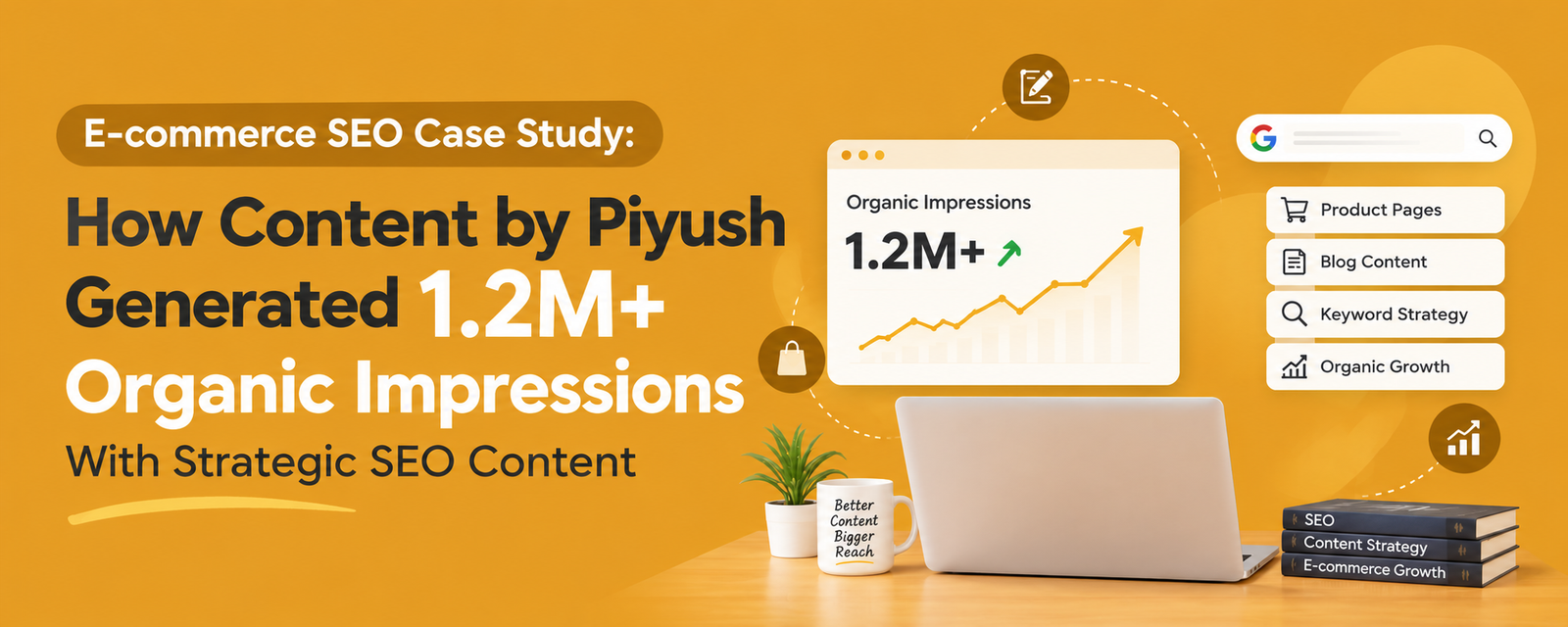
The Result at a Glance
1.2M+ organic search impressions.
That is the headline result of the e-commerce content strategy covered in this case study.
But this is not a story about chasing one high-volume keyword.
It is about building a content system around the questions customers ask before they buy.
The strategy connected:
- search intent
- topic clusters
- commercial content
- category relevance
- supporting informational content
- internal linking
- content quality
and increasingly important:
AI-search readiness.
The objective was straightforward:
Help the e-commerce brand become easier to discover throughout the customer’s research journey rather than relying only on product pages and paid acquisition.
The result was more than 1.2 million organic impressions recorded during the measured period.
This case study explains the framework behind that visibility and, equally importantly, what the 1.2M figure does, and does not, prove.
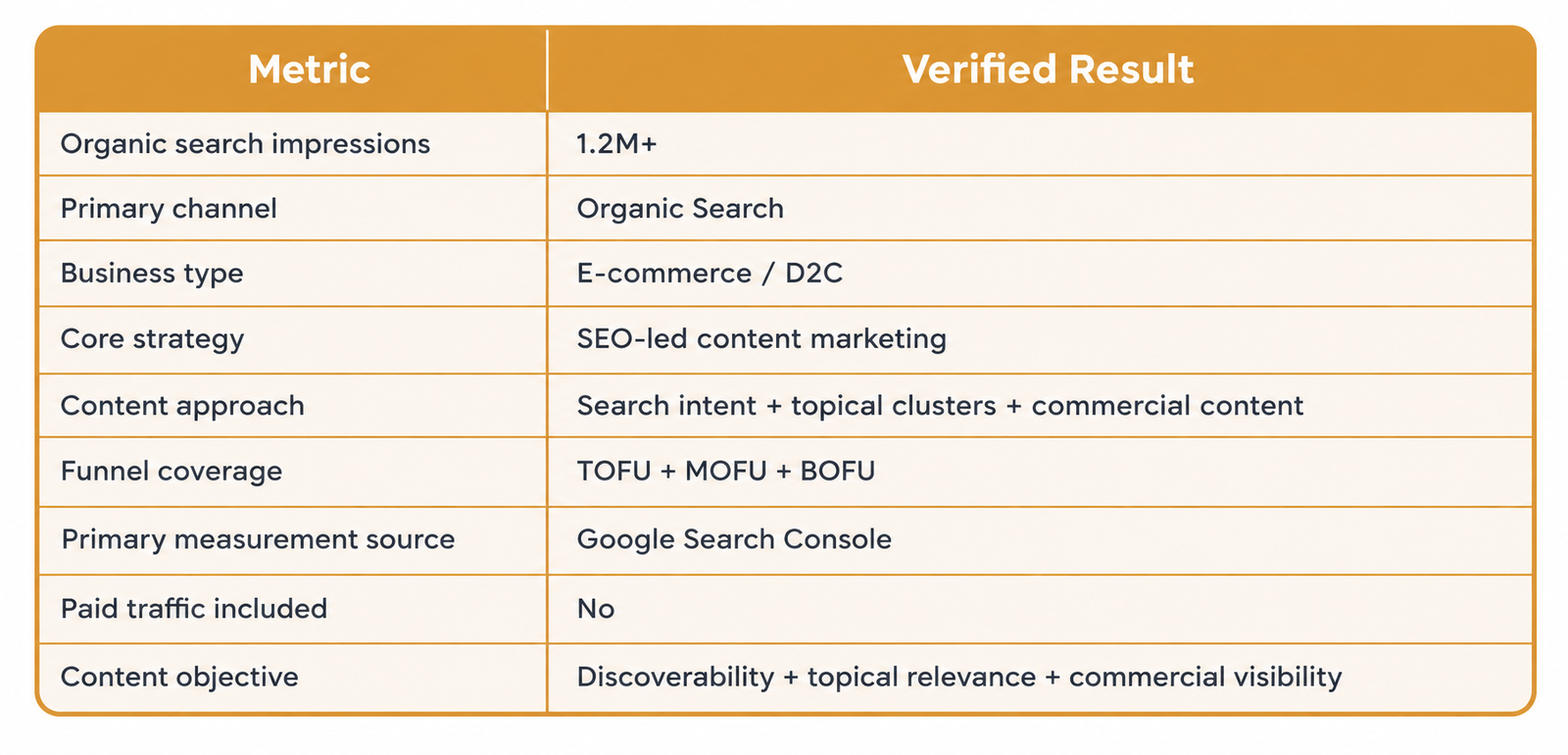
Quick Case Study Snapshotrtise.
Important Methodology Note
The 1.2M+ number should be supported on the published page with the relevant Google Search Console screenshot.
Content by Piyush does not believe a case study becomes stronger by filling missing fields with estimated numbers.
For that reason, this case study does not invent:
- organic clicks
- CTR
- conversions
- revenue
- ROAS
- ranking growth
- lead volume
- AI citations
unless those metrics are independently available in the project’s source data.
That distinction matters.
Specific proof is considerably more useful than impressive-looking estimates.
The Challenge: Good Products Were Not Enough to Build Organic Visibility
One of the most common assumptions in e-commerce is:
If the products are good, people will eventually find them.
Search does not work that way.
A product can be excellent and remain nearly invisible if the website does not communicate the right information at the right stage of the customer’s journey.
The challenge was not simply:
“We need more blogs.”
The bigger problem was that potential buyers were searching before reaching the product page.
They were asking questions.
They were comparing alternatives.
They were investigating materials, use cases, prices and features.
They were trying to decide:
What should I buy?
Which option suits me?
What is the difference between these products?
Is this worth the price?
Which product fits my particular requirement?
A product-focused site cannot capture enough of this demand if its content strategy begins and ends with transactional pages.
That became the central strategic problem.
Why This Matters Even More in AI Search
The buyer journey has become more conversational.
Instead of searching only:
best sarees
someone can now ask:
Which lightweight traditional saree would work for a daytime summer wedding without looking too casual?
Instead of:
running shoes
the query can become:
Which cushioned running shoes under ₹8,000 are suitable for someone running 5 km four times per week?
Google now explicitly describes these journeys as more complex and conversational.
Its Merchant Center AI Performance Insights divides shopping queries across three stages:
Discovery → Evaluation → Ready to Buy.
Commercial search itself is also becoming more exposed to generative results.
A 2026 Semrush study analyzed more than 600,000 keywords across 10 industries and found AI Overviews appearing on commercial-intent SERPs increased by 71% during the six-month study period.
That means e-commerce content can no longer focus exclusively on traditional category keywords.
Brands need visibility during the research that happens before the transaction.
Our Strategic Shift: From Keywords to the Entire Buying Journey
The content strategy was built around one principle:
Do not create content simply because a keyword has search volume. Create content where a relevant customer has a question the brand is qualified to answer.
That changes keyword research considerably.
Instead of building a spreadsheet containing hundreds of disconnected terms, we grouped search demand into customer problems.
For example, an e-commerce topic might break into:
Discovery
What is this product?
Who needs it?
When is it useful?
What materials/types are available?
Evaluation
Which type is better?
How does Product A compare with Product B?
Which option suits a particular use case?
What should someone check before buying?
Transaction
Where can I buy it?
What products are available?
What price range should I expect?
Which collection suits my requirement?
This structure created a much more natural content funnel.
Step 1: We Mapped Search Intent Before Writing Content
Keyword volume alone does not explain why someone searches.
The same topic can contain very different intentions.
Consider:
silk saree
versus:
how to identify pure silk saree
versus:
tissue silk vs organza
versus:
buy handwoven silk saree online
All four relate to the same product category.
But each needs a different page.
The first might belong to a collection.
The second needs an educational guide.
The third needs a comparison article.
The fourth has strong transactional intent.
Trying to force all four onto one page creates a poor user experience.
Creating four near-identical pages creates keyword cannibalization.
The strategy therefore mapped:
query → intent → funnel stage → page type → conversion path
before the writing began.
Step 2: We Built Topic Clusters Instead of Isolated Blogs
One good article can rank.
A connected information architecture can establish authority.
Instead of:
Blog 1
Blog 2
Blog 3
with little relationship between them, the strategy connected content around commercial categories.
A simplified cluster could look like this:
Core Category
Silk Sarees
Supporting education
- What Is Tissue Silk?
- Types of Silk Sarees
- How to Identify Pure Silk
- How to Care for Silk Sarees
Evaluation
- Tissue Silk vs Organza
- Banarasi vs Kanjivaram
- Which Saree Works Best for Summer Weddings?
Commercial content
- Best Lightweight Sarees for Weddings
- Silk Sarees for Festive Occasions
- Sarees Within Different Price Ranges
Transactional destinations
- category pages
- collection pages
- individual products
Every useful article had somewhere meaningful to send the reader next.
That is what turns blog traffic into a business asset.
Step 3: We Prioritized Commercially Relevant Questions
Traffic is not equally valuable.
A broad informational topic can bring thousands of visitors who will never consider the product.
A narrower question can bring fewer visitors but place the brand directly in a purchase decision.
This is why the strategy deliberately included commercial-investigation topics.
For example:
Generic
History of Silk
Interesting.
But potentially far away from a transaction.
Commercial investigation
Tissue Silk vs Organza: Which Saree Should You Choose for a Wedding?
Now the customer is comparing choices.
Even closer to purchase
Best Lightweight Silk Sarees for Summer Weddings
The buyer is defining product criteria.
That is precisely the territory in which modern AI search is growing.
Semrush’s 2026 study found Google AI Overviews expanded much more strongly across commercial-intent searches than transactional ones.
So this part of the funnel deserves considerably more attention than generic TOFU publishing.
Step 4: We Made Every Article Answer the Query Early
One of the easiest ways to weaken an SEO article is to bury the answer.
A visitor searching:
Which saree fabric is best for summer?
does not need:
Since the beginning of human civilization, clothing has played an essential role…
They need an answer.
A stronger opening would say:
Lightweight, breathable fabrics are generally better suited to hot-weather occasions. The right choice then depends on formality, drape, maintenance and budget.
Then explain.
This approach benefits:
users
because they receive value quickly.
search engines
because page relevance becomes easier to identify.
answer engines
because a clear passage can directly address the question.
AI retrieval systems
because individual sections contain meaningful, self-contained information.
The structure used across important articles was:
Question → direct answer → explanation → evidence → example → next step
Not:
keyword → filler → keyword → CTA.
Step 5: We Replaced Generic Claims With Specific Information
E-commerce content often sounds like this:
Our premium products provide unmatched quality and exceptional craftsmanship.
Those words are difficult to verify.
They also provide very little information.
We focused instead on questions such as:
What material is used?
How is the product made?
What size is it?
What occasion is it designed for?
How should it be maintained?
What makes it different from the alternative?
Who is it not suited for?
This is especially relevant after Google’s May 2026 guidance on generative Search.
Google now specifically recommends creating valuable, unique and non-commodity information instead of merely republishing what can already be found across the web.
For e-commerce businesses, proprietary product knowledge is one of the strongest sources of that information.
Step 6: We Connected Informational Content to Commercial Pages
Publishing a blog without a conversion path wastes much of its commercial potential.
Internal links were therefore treated as part of content strategy rather than something added as an afterthought.
A typical journey could become:
What Is Tissue Silk?
↓
Tissue Silk vs Organza
↓
Best Tissue Silk Sarees for Weddings
↓
Tissue Silk Collection
↓
Product Page
That serves two purposes.
First, it helps the reader continue researching naturally.
Second, it clarifies relationships between pages.
Internal linking should not mean inserting:
click here
twelve times.
Anchors should describe the destination naturally.
For example:
explore our tissue silk saree collection
or
see how tissue silk differs from organza
The link becomes useful even before somebody clicks it.
Step 7: We Used Content to Strengthen Category Relevance
Many e-commerce SEO strategies focus heavily on blogs while ignoring category pages.
That is a mistake.
Category pages frequently sit much closer to revenue.
Supporting content should therefore reinforce the categories that matter commercially.
Suppose five educational guides all relate to one category.
Those guides should not remain isolated.
They should support:
the main category
and, where relevant:
subcategories and products.
This creates a clearer topical relationship:
expert explanation → commercial category → product selection.
The strategy was not designed to make the blog impressive.
It was designed to make the store easier to discover.
Step 8: We Treated Content Refreshing as Part of Publishing
An SEO article is not finished on publication day.
Search behavior changes.
Products change.
Statistics become outdated.
Competitors improve.
AI-search interfaces evolve particularly quickly.
For example, Google’s Search Console only completed the worldwide rollout of its dedicated Generative AI performance reporting on August 31, 2026. Website owners can now inspect which pages generate impressions across Google’s generative Search experiences.
Merchant Center now separately reports conversational shopping performance through:
- share of voice
- top terms
- popular attributes
- products showing
- Discovery-stage visibility
- Evaluation-stage visibility
- Ready-to-buy visibility.
An e-commerce content program in 2026 therefore needs an optimization loop:
Publish → Measure → Learn → Update → Strengthen.
The Result: 1.2M+ Organic Impressions
The content program generated more than:
1,200,000 Organic Search Impressions
during the measured project period.
That means pages associated with the website were displayed more than 1.2 million times in applicable organic Google search results during the reporting window.
An impression is not the same as:
a visitor
a lead
or
a sale.
That distinction is essential.
But organic impressions are a useful measure of search visibility because they show the scale at which content is entering relevant search journeys.
The result supports the underlying strategic principle:
Search visibility compounds when a business systematically answers the questions around its commercial expertise instead of depending on a handful of money keywords.
What 1.2 Million Impressions Actually Means
Marketing case studies frequently misuse metrics.
So here is the distinction.
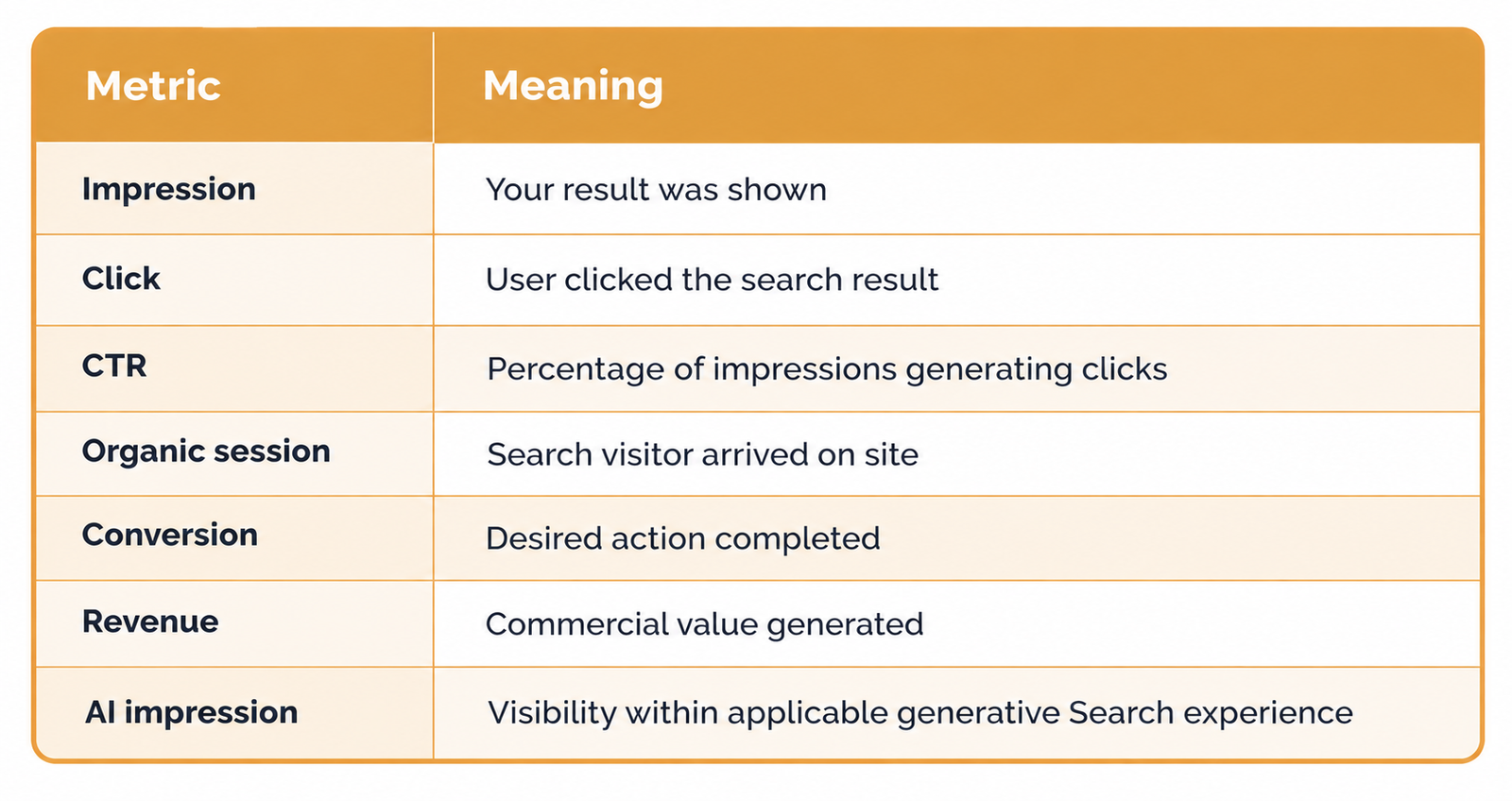
The 1.2M+ result in this case study refers specifically to:
organic search impressions.
It should not be described as:
1.2M visitors
or
1.2M leads
or
1.2M sales.
Precision builds considerably more credibility than metric inflation.
What We Would Measure Differently in 2026
The definition of search performance has expanded considerably.
Historically, the core dashboard consisted of:
impressions → clicks → rankings → conversions.
Today, e-commerce brands should add:
AI visibility
AI share of voice
products appearing in conversational shopping searches
brand mentions
cited URLs
generative Search impressions
ChatGPT referrals
Google’s current Merchant Center AI Performance Insights can even classify conversational shopping visibility into:
Discovery
Evaluation
and
Ready to Buy.
This creates a better feedback loop for future e-commerce content.
If customers repeatedly search for a product attribute that is missing from product data, that is actionable content intelligence.
If a brand performs well during Discovery but poorly during Evaluation, it may need stronger:
comparisons
reviews
specifications
or
buying guides.
Search data should influence what gets written next.
Why This Strategy Is More Relevant After the Rise of ChatGPT Shopping
AI product discovery is moving closer to transactions.
OpenAI’s current shopping experience can surface product options, pricing, reviews, imagery and merchants when a user’s conversation indicates shopping intent.
OpenAI says product relevance can take into account factors such as:
- user intent
- price
- reviews
- ease of use
- availability
- merchant/product metadata.
OpenAI has also expanded merchant product-feed infrastructure, while Shopify product information is integrated through Shopify Catalog.
That makes accurate product information and content depth increasingly important.
SEO content is no longer only competing for ten blue links.
It is increasingly contributing information to a broader discovery ecosystem.
What We Did Not Do
Understanding what was avoided is equally important.
We Did Not Publish Hundreds of Articles for Volume
Publishing frequency was not treated as a ranking strategy.
One useful page serving clear intent can be more valuable than ten overlapping pages.
We Did Not Stuff Exact-Match Keywords
Primary terms helped define search intent.
They did not dictate every sentence.
Semantic relevance came from properly covering the subject.
We Did Not Create a Page for Every Keyword Variation
Examples such as:
best silk saree
top silk saree
best silk saree online
do not automatically require three separate articles.
The decision was based on intent.
We Did Not Treat Schema as a Ranking Shortcut
Structured data can help search systems understand product and article information.
But it cannot rescue weak content.
Google explicitly says there is no special schema required to appear in its generative Search features.
We Did Not Treat AI-Written Volume as a Content Strategy
Google’s guidance remains focused on:
accuracy
quality
relevance
regardless of how content is produced.
The competitive question is therefore not:
Was AI used?
It is:
Does this page provide original, accurate, useful information that deserves to exist?
Why Work With Content by Piyush?
A strategy is easier to evaluate when you know who is behind it.
10+ Years in Content
Piyush Sethia has spent more than a decade working across content writing, SEO-led storytelling and content strategy.
ContentByPiyush’s public profile lists experience managing or creating content associated with brands including:
Samsung
Yatra
Thrillophilia
Shriram Finance
Kotak Securities
and
5paisa.
That experience matters because the challenge changes significantly from industry to industry.
Writing finance content requires different standards from fashion.
Technical content requires a different research process from travel.
E-commerce needs different conversion architecture from thought leadership.
The underlying skill is not simply writing sentences.
It is understanding:
what the audience needs to know
what the business needs to communicate
and
where search demand connects the two.
Recognised as a TallyCircle Expert
TallyCircle currently lists Piyush among its expert members.
The platform describes itself as a verified MSME community designed to connect business owners with experienced specialists and states that its expert support is built around verified experts.
For Content by Piyush, that recognition reinforces a broader shift in the work:
from:
“write me an article”
toward:
“help me determine what our business should be saying online and why.”
That is the difference between content production and content strategy.
Tally MSME Tech Transformer Recognition
ContentByPiyush also identifies Piyush Sethia as a 2026 Tally MSME Business “Tech Transformer” recognition recipient for the use of technology in improving content marketing and writing efficiency.
Tally defines its Tech Transformer category around businesses using technology to improve efficiency and scale.
That recognition is particularly relevant in the current search environment.
Modern content marketing requires more than writing capability.
It increasingly combines:
- research
- analytics
- SEO data
- AI-assisted discovery
- AEO
- GEO
- content operations
- And, human editorial judgment.
Technology should improve the process. It should not remove the expertise.
Recognised as a Top Writer Before AI Content Became the Norm
Piyush’s LinkedIn profile records a Certificate of Top Writer by Get Visible Web, issued in January 2017, along with a Certificate of Appreciation from the same period.
That date matters.
2017 was years before generative AI made basic content production cheap and immediate.
The experience therefore spans two very different search eras:
traditional SEO content
and
AI-assisted search and discovery.
The tools have changed.
The fundamentals have not:
- understand the reader
- research properly
- communicate clearly
- provide evidence
- match intent
- earn trust.
5K LinkedIn Followers and Industry Recommendations
Piyush’s current LinkedIn profile shows approximately 5,000 followers, 500+ connections, and seven professional recommendations.
More importantly, the public recommendations repeatedly reference:
- clear writing
- timely delivery
- professionalism
- ability to manage multiple projects
- understanding requirements
- client handling.
Those are operational qualities.
And large content programs require operational discipline just as much as creativity.
A 30-page content plan is worthless if:
- deadlines slip
- research becomes superficial
- tone changes every week
- Or writers misunderstand the audience.
Consistency is part of SEO.
Writer, Strategist and Author
Piyush is also the author of The Clarity of Confusion.
That side of his work is useful because SEO writing and storytelling are often incorrectly treated as opposites.
They should not be.
Search tells us:
what somebody wants to know.
Storytelling determines:
whether they care enough to continue reading.
A high-performing piece of content needs both.
ContentByPiyush therefore approaches content through three connected lenses:
Search
Can people discover it?
Understanding
Can people quickly understand it?
Persuasion
Does it give them a reason to continue, trust or act?
That combination is particularly important for e-commerce and D2C brands.
The Content by Piyush Framework
The work can be summarized through a simple framework:
R — Research
Understand:
- the audience
- SERP
- competitors
- customer language
- search intent
- product
- business objective
E — Evidence
Add:
- primary sources
- original data
- product information
- real examples
- screenshots
- expert insights
A — Architecture
Map:
- topic clusters
- search journeys
- page types
- internal links
- funnel stages
C — Clarity
Write:
- direct answers
- useful headings
- clear examples
- readable explanations
- strong transitions
H — Human Value
Ask:
Would this page still be worth reading if Google did not exist?
Together:
REACH
Because ranking is useful.
But the real objective is reaching the right customer with the right information before the buying decision is made.
Why Content-Led SEO Can Compound
Paid acquisition works while budget continues.
Organic content behaves differently.
A useful guide published today can continue generating:
- impressions
- clicks
- internal-link authority
- brand discovery
- and potentially: AI citations months after publication.
That does not make SEO free.
Research, writing, editing, technical implementation and optimization all cost resources.
But high-quality content creates an asset rather than a temporary placement.
The 1.2M+ impressions in this case study illustrate that compounding visibility.
Can the Same Strategy Generate 1.2M Impressions for Every Brand?
No.
And no credible SEO professional should promise that.
Results depend on variables including:
- industry demand
- competition
- domain history
- website authority
- product-market fit
- site architecture
- technical SEO
- publishing resources
- backlinks
- existing rankings
- content quality
- seasonality
- algorithm changes
The useful part of this case study is not:
Copy these steps and receive exactly 1.2M impressions.
It is:
Build your organic strategy around buyer intent, topic depth, commercial relevance, strong information architecture and measurable evidence.
The number will vary.
The framework remains useful.
Is Content by Piyush an E-commerce SEO Agency?
Content by Piyush specializes primarily in content-led organic growth rather than pretending every SEO challenge is a writing problem.
Services relevant to e-commerce and D2C businesses include:
- SEO content writing
- e-commerce content strategy
- category and collection content
- buying guides
- comparison content
- blog and article writing
- content audits
- search-intent mapping
- internal-link planning
- AI-search content optimization
- AEO/GEO content strategy
- content refreshing
- research and analysis
If a problem is primarily technical, for example severe crawling, rendering, JavaScript or server issues, it should be handled with the appropriate technical SEO or development expertise.
Good consulting starts by identifying the actual problem.
Not by forcing every problem into the service you sell.
When Should an E-commerce Brand Invest in SEO Content?
Content-led SEO is worth considering when:
Paid acquisition has become expensive
Organic visibility can diversify acquisition.
Product pages rank but research-stage traffic is weak
You may be missing Discovery and Evaluation searches.
Competitors dominate buying guides and comparisons
They are influencing customers before those customers reach you.
You have strong product expertise that is not visible online
Turn that knowledge into searchable assets.
Category pages lack supporting authority
Build relevant informational clusters around them.
Your content generates traffic but not commercial movement
Rebuild the funnel and internal linking.
Your brand wants AI-search visibility
Strengthen product information, expertise, entity signals and source-worthy content.
What Should Businesses Ask Before Hiring an SEO Content Partner?
Do not ask only:
How many words do I get?
Ask:
How do you map search intent?
How do you decide whether something deserves a new page?
How do you verify statistics?
How do you prevent keyword cannibalization?
How will informational content support commercial pages?
What gets measured?
Can I see Search Console evidence?
What happens after publication?
How do you update content?
How are AI Search, AEO and GEO incorporated without sacrificing SEO?
The answers reveal whether you are buying:
words
or
strategy.
Final Takeaway
The most important number in this case study is:
1.2M+ organic impressions.
But the real lesson sits behind the number.
Search growth did not require writing about everything.
It required becoming more useful around the subjects commercially connected to the business.
That meant:
understanding buyer questions
↓
mapping intent
↓
building topic clusters
↓
creating useful content
↓
connecting it to commercial pages
↓
measuring performance
↓
improving what worked.
AI search makes this approach even more relevant.
Google now measures conversational commerce across Discovery, Evaluation and Ready-to-Buy journeys.
ChatGPT increasingly supports product discovery and comparison.
And Google is explicitly asking creators to provide information that is unique, useful and difficult to replace with generic summaries.
The objective is therefore bigger than ranking one article.
It is to make your brand useful enough to be discovered throughout the buying journey.
Want to Build an Organic Content Engine for Your E-commerce Brand?
If your products deserve more visibility than they currently receive, Content by Piyush can help identify where content is losing search demand—and build a strategy around the questions your customers actually ask.
From SEO content writing and topic clusters to e-commerce content strategy, AEO and GEO, the focus stays on one principle:
Every page should have a purpose, every claim should have evidence, and every piece of content should move the business closer to measurable organic visibility.
Frequently Asked Question
How did Content by Piyush generate 1.2M+ organic impressions?
The strategy combined search-intent research, topic clustering, commercially relevant content, clear answer-led writing, internal linking and ongoing SEO optimization. The 1.2M+ figure refers specifically to cumulative organic search impressions measured for the project.
What is an e-commerce SEO case study?
An e-commerce SEO case study documents how search optimization affected an online store’s measurable organic performance. A strong case study should explain the starting problem, strategy, implementation, measurement source, timeframe and actual results rather than presenting numbers without context.
Are organic impressions the same as website visitors?
No. An impression occurs when an applicable page is displayed in search results. A click occurs when the user selects that result. Website sessions, leads, sales and revenue are separate metrics.
What is the best content strategy for an e-commerce website?
There is no universal template. A strong e-commerce content strategy normally connects product and category pages with discovery content, comparisons, buying guides, FAQs and other resources based on actual customer search intent.
Can SEO content help an e-commerce brand appear in Google AI Overviews?
Potentially. Google says its generative Search features rely on its core Search infrastructure and recommends unique, useful, non-commodity content. As of August 31, 2026, Search Console also provides dedicated generative AI impression reporting globally.
Can e-commerce products appear in ChatGPT?
Yes. ChatGPT can surface products when conversations contain shopping intent. OpenAI says product and merchant selection can consider relevance, price, reviews, availability and merchant/product metadata. Shopify Catalog is already integrated for applicable Shopify product data.
How long does e-commerce SEO take?
There is no fixed timeframe. Results vary according to competition, domain history, technical health, content quality, authority and search demand. Be cautious of anyone guaranteeing a specific ranking or traffic level within a universal timeframe.
Who is Piyush Sethia?
Piyush Sethia is a content marketer, strategist and writer with more than a decade of experience. His public profile includes work across major brands, a 2017 Top Writer certificate, professional recommendations, authorship of The Clarity of Confusion, recognition within the Tally ecosystem and expertise spanning SEO content, content strategy, AEO, GEO and organic-growth planning.
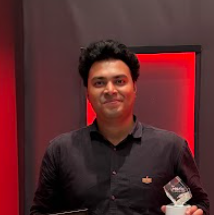
Piyush Sethia
Co-Founder | Content Marketer and Strategist
Recognised as the 2026 Tally MSME Business 'Tech Transformer' Award winner, Piyush Sethia leverages advanced tech facilities to transform content marketing and writing efficiency. With over a decade of experience, he specializes in data-backed content marketing, AIO, GEO, SEO strategy, and organic growth blueprints. He is also the author of The Clarity of Confusion, showcasing his unique ability of storytelling and simplifyinig complex landscapes into crystal-clear narratives. His expertise lies in converting technical data and deep audience insights into engaging, search-optimized strategies that drive sustainable traffic.
No Responses